Written by Lydia Williamson-Sawyer
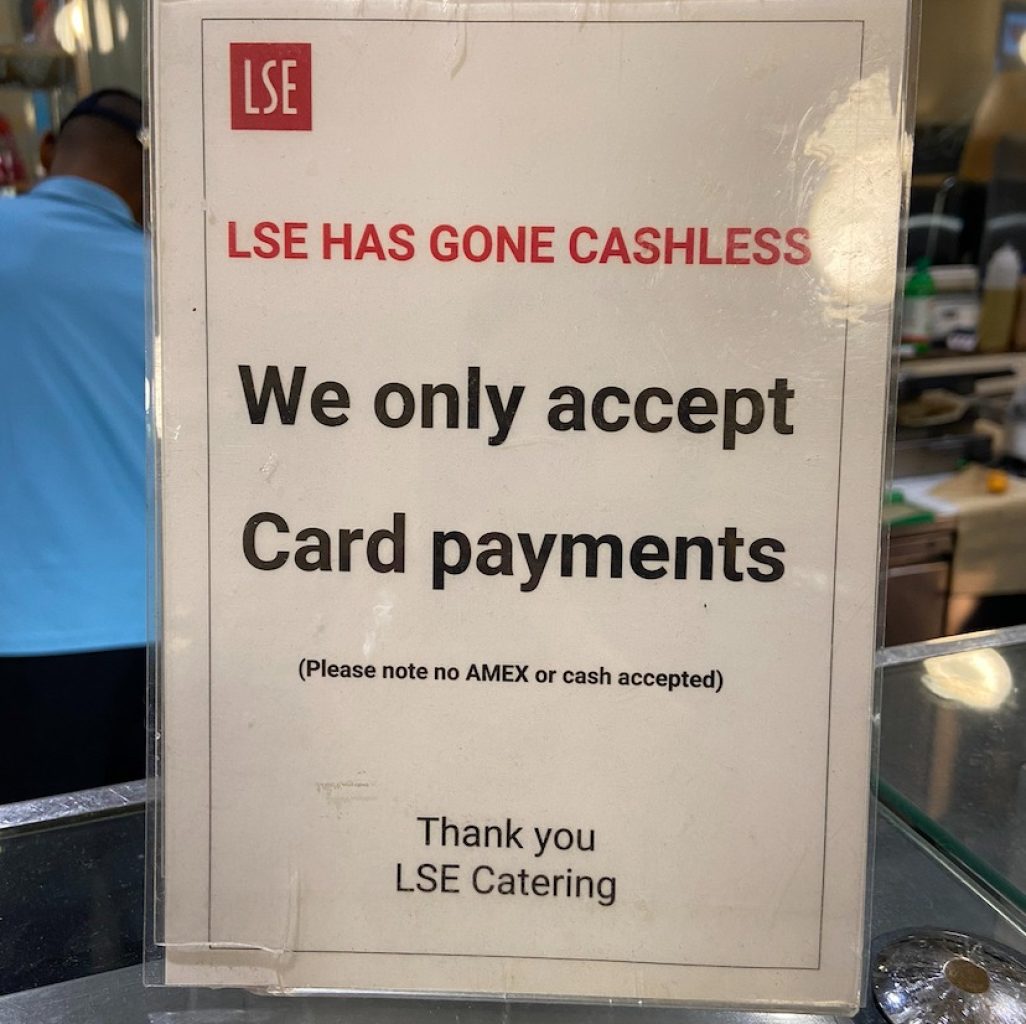
Cash is disappearing. Everywhere we go, cafes, train stations, supermarkets, even at LSE, we are being pressured towards a world where only digital payments are accepted. We are told that abandoning cash will bring convenience and ease. Yet the quiet transition to a cashless future presents a risk to our civil liberties, digital security, and economic resilience.
It’s an alluring story. Emerging digital technologies promise to deliver efficiency, freeing up time to enjoy leisure, relaxation, and the things that matter. From apps that streamline our shopping to AI assistants that manage our schedules, we are sold a vision of a digital future where technology is the driving force in making our lives more productive and enjoyable.
The subtle removal of our ability to pay with cash, which has accelerated since the pandemic, rests on this story of digitally enabled progression and convenience.
But pause for a moment. Have digital technologies really made us freer, happier, and more relaxed? In reality, digital technologies rarely give us time to enjoy the delicacies of life. Instead, they accelerate the pace of how we live, speeding up production and consumption, keeping us scrolling, tapping, and increasingly dependent on digital systems.
As LSE Professor Nick Couldry, an expert in data and digital platforms, puts it:
“This is one of the first areas of society where we’re being offered a form of order in a very important dimension of the economy — paying — that doesn’t allow for any space outside of regulation, and that is a big deal.”
Despite the risks, the move towards cashlessness is happening right under our noses, with little critical debate.
The Profit Motive Behind Convenience
Rather than uncritically adopting the myth that digital technologies bring ease and convenience, we need to question who benefits from a cashless future. When we can no longer pay with cash, we are forced to rely on digital payment systems run by banks, payment companies, and financial technology firms. Whilst cash is a public infrastructure, digital payments are another step towards privatisation.
We are already witnessing the risks of digitised corporate control encroaching on our lives. Eerily specific targeted advertisements, personal data leaks, and the normalisation of intrusive surveillance illustrate how far corporately-owned technologies are from liberating us.
Take Revolut’s advertisement on the London Underground in 2019: “To the 12,750 people who ordered a single takeaway on Valentine’s Day. You OK, hun?” This is what it looks like when invasive data extraction from powerful corporations is normalised and joked about.
Paying digitally enables corporations to track, analyse, and sell our transaction data, building up ever detailed consumer profiles about each of us. This data can be used to control access to goods and services, influence spending, and track behaviour.
As Professor Couldry explains: “We’re creating situations that bring with them the certainty that everything you do must be tracked, and that has implications for the nature of the social order itself”.
Dangers of Digital Dependency
Moving to a cashless system not only threatens our autonomy and security but also undermines economic resilience. In Sweden, plans to move to an entirely cashless system were dropped when authorities realised this would leave the country susceptible to cyber attacks and digital warfare. Whilst in Spain, a recent power outage brought the entire digital payment system to a halt. The growing risks of system failures, financial instability, and natural disasters point to a future where total dependence on digital systems leaves us vulnerable.
Transitioning to digital payments is not a race to keep up with to avoid being left behind, as the financial sector would have us believe. By accepting this framing, we are falling into the trap of seeing speed and optimisation facilitated through digital technologies as the only way forward. Nearly one million adults in the UK don’t have a bank account, along with many older and disabled people who are digitally excluded and rely on cash. Moving to a digital payment system is not progress: it’s a deepening of exclusion disguised as development.
Keeping cash alive as an alternative to digital payments is a refusal to let the horizon of possibility be determined by the financial elite. Cash is an insistence that there’s an alternative future beyond surveillance, digital dependency, and the centralisation of economic power. The question is whether we will defend our right to cash whilst we have the chance.