
Written by Hareem Hassan Khan
Illustrated by Sylvain Chan
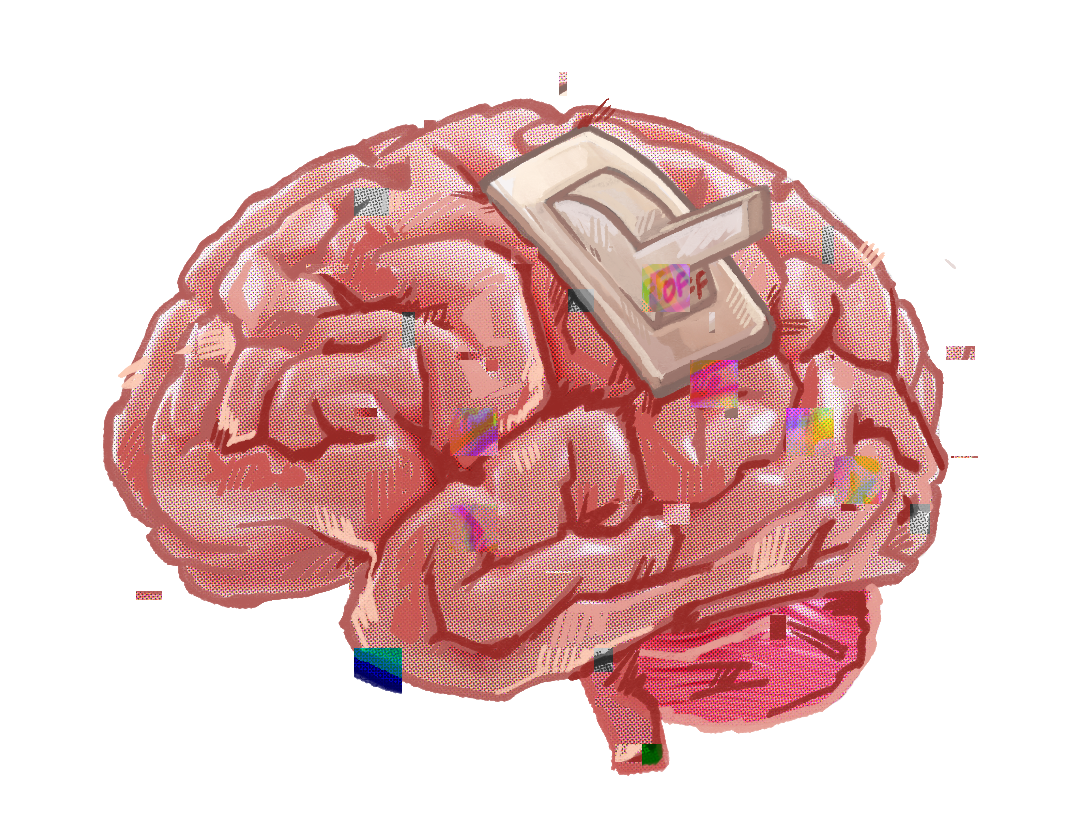
Our increasing tendency to outsource our thinking to a bunch of code is resulting in surging rates of loss of intellectual agency and cognitive decline. And yet we have all done it, at least to some extent. We all feel handicapped without our trusty AI companion to wheel us through the more analytical and strategic aspects of life — be it an essay or planning a trip itinerary. However, do you remember those frightening times when we wrote our emails ourselves? Artificial Intelligence’s accessibility has not been present in the public realm for that long, which is why the startling drop in attention spans and reading scores is certainly a cause for concern. A recent MIT study furthers the alarm, by highlighting how people using AI assistants for aid in writing essays cannot even recall the content of their own essays, and cite lower feelings of ownership towards their work. The outsourcing of their thoughts to AI assistants, choosing to upload their minds online, has deleted their own brains in the process.
Humans are evolutionarily primed to incline towards technology that reduces the friction on our brains; AI is certainly creating a frictionless society, where we seamlessly glide from one open tab to another, offloading our mental burdens onto the screen. However, the brain needs friction to develop the essential cognitive skills to navigate the dwindling boundary between cyberspace and reality; cognitive skills which are lost to dependence on Artificial Intelligence. At least Google requires us to sift through multiple search results before choosing the most satisfactory one, forcing us to use our cognitive and decision making skills. In contrast, AI assistants simply provide the users with information immediately, whether it be true or false.
Such a decline in cognitive ability will raise a generation lacking empathy and logical reasoning — a generation easier to control and brainwash. Most AI assistants simply tell their users whatever they want to hear, echoing their own thoughts back at them, even if they are incorrect. This instils an expectation within people to always be perceived as correct, ensuring they cannot handle disagreements well or even consider differing opinions. Instead, they choose to be the ‘main character’ in their own self-constructed bubble, with their loyal AI sidekick to provide the regular ego boost. Such reinforcement of one’s own beliefs leads to isolation from diverse viewpoints and confirmation bias, resulting in a generation more susceptible to misinformation and extreme political polarisation. Furthermore, cognitive decline prevents people from distinguishing between the truth and fabrication, becoming fertile ground for the government to embed manipulation and control tactics through increased media regulation; the results of which are evident in the global shift towards extreme political ideologies and populism. Lowered rates of democracy and surging rates of violent suppression across the world will not remain a cause for concern for very long if people do not even understand why they need to be concerned, or realise that their rights are being violated under increasingly authoritarian regimes.
George Orwell’s novel 1984 is manifesting in a sinister way in the 2020s, where we are willingly reducing our own brain power by allowing a machine to think and decide for us: a machine many of us do not even understand the inner workings of. We are entirely dependent on a bunch of code. AI is here to stay, but it should not have an inverse relationship with our own brains. The rise of AI should not result in a rise in ignorance. We all need to re-evaluate our habits and make appropriate changes to navigate such dangerous times.