Written by Anna Alexiev
Illustrated by Laura Liu
In the weeks following the publication of Vogue’s viral article “Is Having a Boyfriend Embarrassing Now?”, the internet has done what it does best. We’ve taken a headline, detached it from its context, and sprinted full force with whatever interpretation feels most entertaining, most affirming, or most provocative. The reaction has been less a conversation and more of a mass game of telephone, where the original message becomes increasingly unrecognisable.
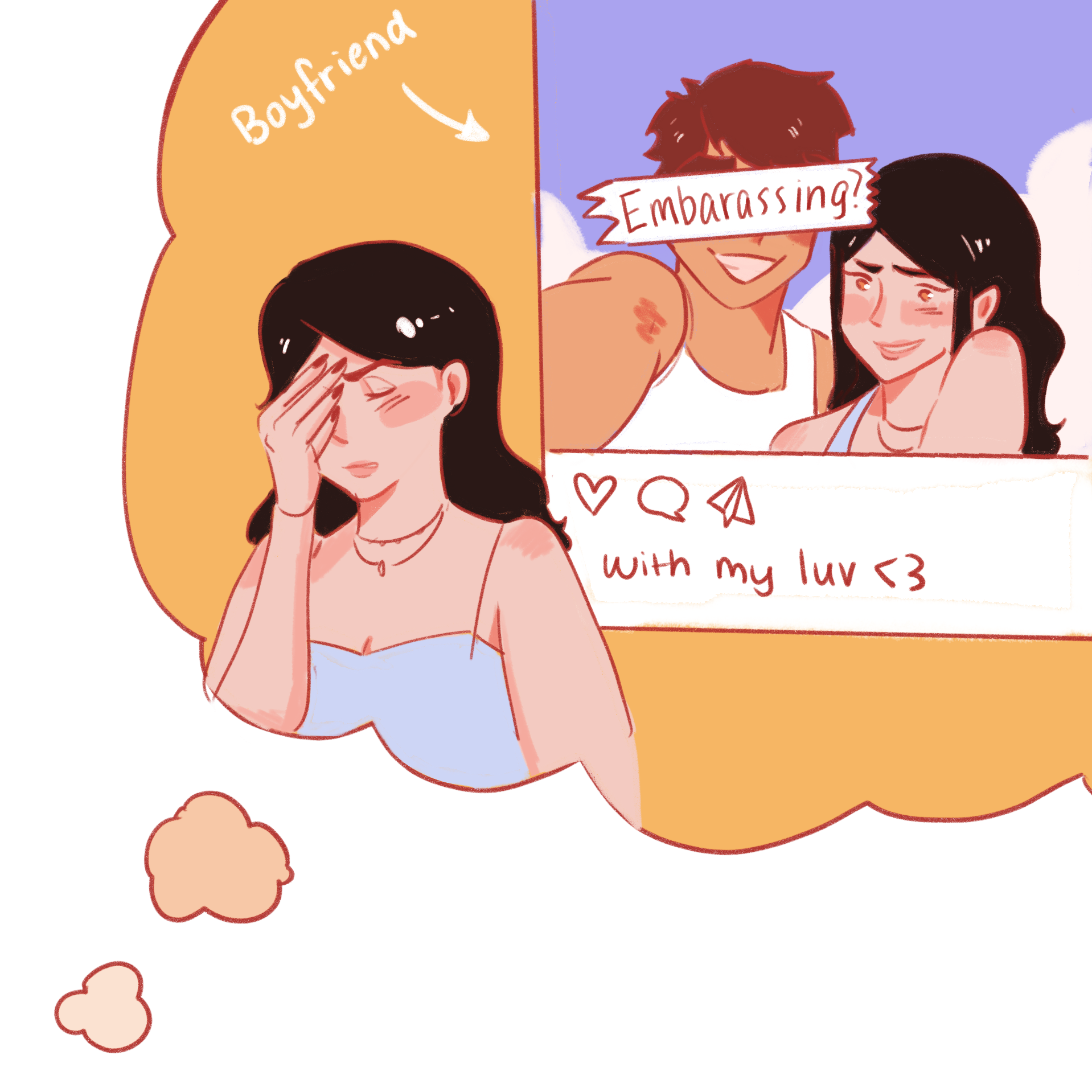
The article itself is not nearly as sweeping or inflammatory as its reception suggests. It attempts to touch on trends, yes, but without offering the kind of grand feminist statement people seem determined to extract from it. For example, the piece lightly introduces the idea of “Boyfriend Land”, a sort of conceptual space where women’s identities historically became overly linked to their partners, a dynamic we seldom see applied to men. But the article never really digs into the deeper implications of that idea. Instead, it uses it as a backdrop for something far more superficial: the “soft launch”. The subtle, mysterious introduction of a partner online. Vogue frames this as a sign of embarrassment or reluctance among women to be seen as coupled. But even this feels like an oversimplification. Plenty of people soft-launch their relationships not to hide them, but because it looks better on the feed. Not everything is symbolic, and sometimes a cropped shoulder really is just a cropped shoulder.
When the author claims, “Women are obscuring their partner’s face when they post, as if they want to erase the fact they exist without actually not posting them”, the statement begs for actual evidence. Given the rise of the clean girl aesthetic, with a focus on minimalism, decluttering, and a fixation on smooth visual harmony, it’s far more plausible that faceless boyfriends exist because aligned colour palettes look better than someone’s unfiltered, shadowy expression. Relationship privacy has become an aesthetic choice as much as a personal one. So interpreting this as shame rather than simply curation seems less insightful than it does reactionary.
The article becomes more interesting when it introduces “heterofatalism”, the sense among many women that heterosexual relationships are exhausting, disappointing, or doomed. This is a genuine phenomenon, one that countless conversations among friends attest to. But again, recognising exhaustion is not the same thing as feeling embarrassed by the idea of dating men. Vogue claims that, “women don’t want to be seen as being all about their man, but they also want the clout that comes with being partnered up”, which feels like an attempt to diagnose a contradiction that isn’t actually as universal as suggested.
In reality, most women I know still talk about relationships, whether they be potential, imagined, disastrous, or hopeful, because the topic is inherently human, not because they’re trying to impress anyone or keep up appearances. The implication that women are calculating their romantic image with such strategic precision feels exaggerated, especially compared to the mundane truth that dating, in general, is simply confusing.
Then, the article pivots to a claim that women avoid posting relationships because they fear inspiring jealousy. This sudden shift from “empowerment narrative” to “women tearing each other down” is whiplash-inducing. It reduces women back to a familiar, unhelpful stereotype, undermining the supposedly progressive framing the article tries to project. And when Vogue solemnly mentions the sorrow of imagining a breakup and being “stuck with the posts”, it presents this as a uniquely modern anxiety. When, in reality, older generations had entire physical albums filled with ex-partners that they eventually stuffed in closets or threw into bonfires. A digital delete button is hardly a more dramatic burden than a shoebox of Polaroids.
But what’s missing almost entirely from the conversation is the impact on men. The enthusiasm with which the internet has embraced the idea of boyfriends being “embarrassing” is surprisingly vicious. Comments such as “Why does having a boyfriend feel Republican?” or “Boyfriends are out of style until they start acting right” rack up tens of thousands of likes, all under the guise of humour or girlboss irony. Yet if you flipped the script and the article were titled “Is Having a Girlfriend Embarrassing Now?”, the reaction would be vastly different. Vogue is not a satirical outlet but a long-standing cultural authority. For decades, it has shaped trends, narratives, and even sociopolitical aesthetics. So, brushing off this tone as harmless or playful feels disingenuous. Cultural institutions don’t get to make jokes without consequences, even if the tone is half-heartedly tongue-in-cheek.
There’s also the sweeping statement that being in a relationship makes women “become more beige”, less vibrant online, and less interesting. This is a very bold generalisation dressed up as observation. Some women feel more themselves in relationships, not less. Some feel freer when single. Some feel beige all the time. The idea that a woman’s personality becomes diluted simply because she posts a boyfriend is not an analysis; it’s a projection. And it’s one that arguably says more about the pressures of online performance than about relationships themselves.
To be fair, the author ends on a genuinely thoughtful note with the reminder that there is no shame in seeking love, avoiding love, or failing at love. That part is grounded and generous. But it’s a shame that the subtler ending is not what people chose to run with. Instead, the title became a meme, a slogan, and a pseudo-feminist catchphrase that people deployed without reading the article at all. And if we’re being honest, this tendency to reduce complexity to a caption is something we see not just in media consumption but in how we handle relationships themselves. Even when we avoid explicitly posting our partners, we still post the candlelit dinners, the matching cocktails, and the backlit silhouette. We still perform romance; we just do it implicitly. Men do this too, though they’ve long framed singleness as aspirational through bachelor culture. If women are now trying out their own version of that narrative, perhaps that’s less about embarrassment and more about equality in self-mythologising.
The article’s claim that singleness has become a fully “desirable and coveted status”, flipping centuries of stigma on its head, is wishful at best. Yes, cultural conversations have shifted. Yes, independence is celebrated more openly now. But the old narratives linger, persistently shaping expectations and judgements. We’re not living in a post-spinster world, but in a world that has rebranded its pressures with prettier language.
Ultimately, the real issue isn’t whether having a boyfriend is embarrassing. It’s how a headline, a trend, or a single sentence can be stretched until it becomes something extreme, something divisive, and something it was frankly never meant to be.