Written by Caitlin Yao
Illustrated by Sylvain Chan
Orientation, tea and biscuit socials, free tote bags…if you’re reading this, the whirlwind of Welcome Week probably feels like a lifetime ago. If, like me, you have been an introvert all your life, the combination of excitement and apprehension during Welcome Week is probably no stranger to you. The truth is, despite going through three different welcome weeks across two universities, I have still not cracked the code of socialising—but as I’ve discovered, that’s okay. We don’t really need to scramble for friends; long-lasting friendships can be forged gradually, and you often find your people through the most unexpected ways.
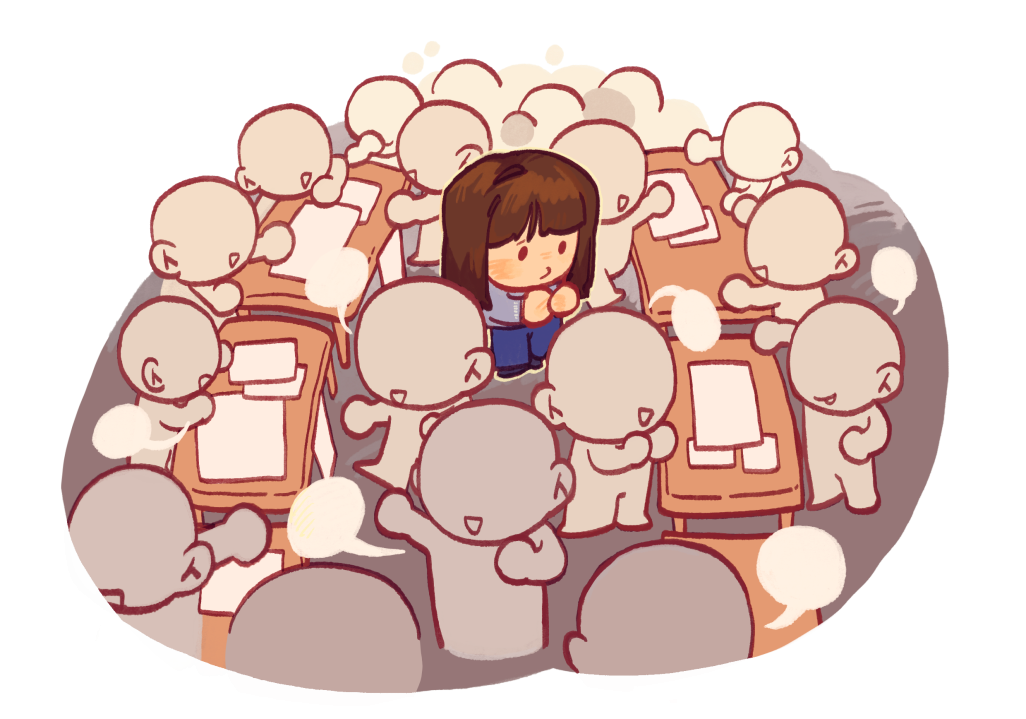
Looking back, there seemed to be a lot of implicit expectations for Welcome Week: to remember at least 50 new names and faces, go to as many club nights as possible, and potentially be someone you aren’t. Now that the dust has settled and real routines have begun, it’s easier to see how much of that pressure was self-imposed—and how quickly it fades once seminars, readings, and the rhythm of actual university life take over. What felt urgent in those first few days often matters far less a few weeks in. It’s often easy to forget that there is no pressure to do anything. If an event gets overwhelming, it’s alright to leave early; if you are agonising over whether to join a conversation, it’s okay to have a cup of tea by yourself first. While a single event might seem like the only opportunity to meet people, it’s not. There will be plenty of time later in the year to bond, whether it’s through a random society event or shared misery over readings and assessments. Many societies host Give It A Go sessions and events that don’t involve clubbing, drinking, or large-scale socialising. I would personally recommend the SU Visual Arts and Crafts societies’ events if you are looking for something a bit calmer.
Most likely, the connections that formed gradually over a longer period of time might be more meaningful than the disorienting scramble of the first week. We can sometimes unconsciously subject ourselves to the pressure of being a stereotypically sociable and talkative person during Welcome Week, or sign up for far too many events just because everyone seems to be doing so. For any fellow introverts, this could mean masking who we truly are, which can be incredibly tiring! As cliché as it sounds, it is always helpful to remember that we forge genuine, enduring connections by being ourselves. Here’s something I wish I’d known sooner: many freshers only really start finding their people weeks or even months into the year. The friendships that stick often aren’t the ones forged in the chaos of Welcome Week, but the ones that emerge later. If you’re reading this and still feel like you haven’t quite found your circle yet, you’re not behind. You’re right on schedule. There is no ‘right’ way of spending your first few weeks at university, and you can always pace yourself when you need to.
Welcome Week does not look the same for everyone. For me, it was tricky to strike the right balance between the pleasure of meeting new people and the pressure of socialising. Now, after a term, I can see how my comfort levels have shifted—not because I suddenly became an extrovert, but because familiarity breeds ease. The same faces in seminars start to feel less like strangers; the same coffee shop becomes a quiet anchor. Social energy ebbs and flows, and that’s normal. It is always important to step back and remind ourselves that it’s okay if we haven’t made a million new friends in a week, and it’s okay if our first week looks nothing like those popular Instagram posts. While the start of a new journey is undeniably exciting, it is never a bad idea to prioritise ourselves and ensure we do not force ourselves into situations that might make us uncomfortable. As we have now gradually shifted into the more academic aspect of university, it becomes all the more important to look after ourselves. Putting our well-being and mental health first will have the magical effect of making everything else easier to navigate—including the mystery of friendship.