Written by Nhu Hong Pham
Illustrated by Laura Liu
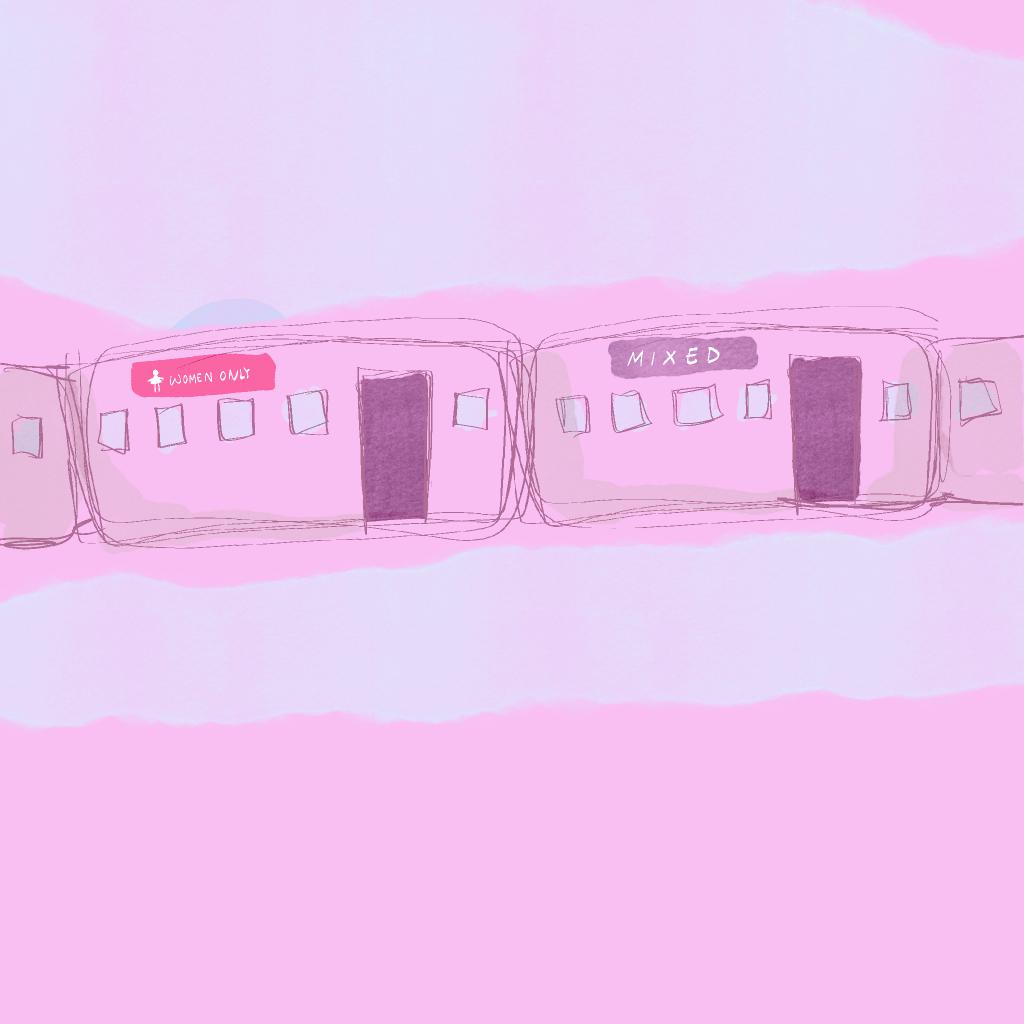
In October 2025, over 12,000 people signed a petition demanding women-only tube carriages in London. More and more, we see women-only spaces emerge in various types of public spaces: from swimming sessions at public pools to sections in transport (as seen in India and Indonesia). However, I strongly believe women-only carriages and other public places have pushed us a step backwards. When our proposed solution to threats and violence is to remove women from shared spaces, we stop asking men to change and start asking women to disappear.
Public spaces are places for everyone, regardless of identity, to participate in and enjoy. With reported or unreported incidents of sexual harassment, violence, and abuse, the aspect of enjoyment for women in public spaces is increasingly compromised, triggering the introduction of women-only initiatives. But do they really work to protect women? Or are they a way of diverting our attention away from the root causes of the problem?
The Question of Safety
The first and central argument for women-only spaces is to provide safety and peace of mind for women in communal places. The numbers paint a grim picture. Sexual offences have been on the rise for the past five years, climbing from around 19,000 cases recorded in London in 2019/20 to over 26,000 in 2024/25. British Transport Police figures show 792 sexual offences reported on the Tube in 2025 alone, with the Northern, Victoria, and Central lines accounting for over 40% of all cases. But these statistics barely scratch the surface. Farah Benis, founder of “Catcalls of London”, has collected over 27,000 testimonies from women who’ve experienced harassment on London’s transport network — many of whom never formally reported such incidents.
The proposal for women-only carriages only offers immediate relief: for women to feel safe without carrying the fear of being at risk. But does segregation actually prevent harassment, or does it simply move the problem elsewhere? The uncomfortable truth is that women-only carriages protect women from all men, not just predators. This creates two problems: ‘ordinary’ men feel unjustly accused and defensive, while actual perpetrators face no accountability or education. The men who harass women won’t suddenly change their behaviour — they will simply change their targets to women in mixed-gender carriages. Meanwhile, the ones who feel wrongly accused will bear the psychological impact of being viewed as a potential threat.
And what happens when women step off that segregated carriage? If we assume women need separate carriages for safety, this logic implies that we need greater segregation in public spaces such as mixed-gender pubs, streets, and workplaces as well. If separation is the solution, where does it end? Frankly, we are treating segregation as progress.
Inclusivity
A problem of inclusivity also arises when we consider transgender and non-binary people. If we were to accept women-only carriages, we would create spaces that do not account for them at all — they are subject to the uncomfortable task of justifying their presence while navigating a system that was not designed with their existence in mind. Trans women entering a women-only carriage may face stares, whispers, or direct confrontation from those who question their presence. Non-binary people are erased entirely from the conversation, as if gender exists only in two categories. These aren’t abstract concerns: they’re daily calculations about safety and dignity that some people never have to make.
“Separate Has Never Been Equal”
The irony is hard to ignore. We’re creating safety through separation — yet separation is exactly what women spent centuries fighting against. Past gender segregation determined where each gender was designated to be, telling us what to do, where to go and what not to meddle with. So why are we re-introducing this concept? I wonder if spaces to women only on public transport will inadvertently reintroduce and amplify the very idea that women and men cannot — or should not — share the same space, as if our coexistence is inherently problematic.If we do not include the other side in the conversation, what are we doing but polarising each other even more? These women-only initiatives, to me, feel like putting Band-Aids on a systemic wound. I imagine we all wish things could have been simpler, that being together in one place would not entail discomfort and worry, and that everyone would know how to act appropriately in social settings. But wishing does not create change. But neither does separation. Real safety comes from real accountability: consequences for the perpetrators, education for all, and a society that does not tolerate harassment of any kind. By not addressing the root cause of the problem, whether on a personal, social, or structural scale, we risk exacerbating the problem further without improving lives. Separate has never been equal. And safe should never mean separate. If we’re serious about women’s safety, we need to move beyond temporary fixes and demand better from our institutions, our communities, and ourselves.