Written by Amelia Hancock
Illustrated by Oliver Chan
Now in its fourth year, the RAG Fashion Show returned to The Venue and Marshall Building with a concept that felt particularly close to home for the average LSE student.
This year’s theme was ‘Culture Capital’, a term coined by the sociologist Pierre Bourdieu that refers to the knowledge, skills, and cultural background that enable social mobility and confer status. For Creative Director Bryon Lim, the idea was less about theory and more about lived experience.
His interpretation centred on the reduction of London’s arts and culture history and its replacement with the conformity of corporate culture. Moving from Singapore to London for university, Bryon expected to be immersed in the arts and creative scene. Instead, he encountered a city increasingly shaped by gentrification, modernisation, and perhaps the most recognisable to LSE students, the finance pipeline.
As noted in his opening speech, many arrive at LSE believing law, consulting, and high finance are the “answer to life”. However, he “couldn’t imagine how anyone could be interested in this”. This tension in his own journey directly inspired the show’s five acts, following a student’s journey from embracing the conformity of the finance world to pushing boundaries and experimenting with self-definition.
Act 1: The Stereotypes
The show opened as if you had stepped into Canary Wharf at rush hour. Tailored suits dominated the runway. The looks were structured, monotone, and deliberately repetitive. This act mirrored the corporate world dress code: powerful and immaculately put together.
Act 2: Corporate Fatigue
The second act started to show cracks in this conformity. The shift began subtly. A second tie. Trousers unbuttoned. A popped collar. One standout look, modelled by Guy Yashiv and designed by Ayanat Arynova, perfectly captured this transition. Conservative and structured on top, the look dissolved into nothing but red boxers below.
As the music intensified, so did the deconstruction. Tailoring loosened. More colours and materials emerged. Hair and makeup became playful rather than polished. By the end of the act, the suit had been dismantled, and corporate fatigue had set in.
Act 3: Childhood Dreams
This act shifted the pace entirely. The walks became slower as the music softened. This act felt dreamlike and disjointed, as if I had stepped into a memory.
One model wore a sheer, flowing dress layered over bright yellow tights, while another stepped out in a t-shirt, plaid shorts, and Timberlands. These looks rejected the corporate world entirely, while others nodded to it. The styling felt mismatched, clashing, and experimental. A sharply tailored silhouette, unexpectedly paired with a long fur coat. A pink plaid-patterned dress over blue tights. It was intentionally confusing. A return to childhood dreams and ambitions before they were packaged into corporate job titles. Asking the question, who were we before the suit? Before university?
Act 4: Missing Home
In this act, cultural heritage moved to the forefront. The corporate silhouette remained visible, but the materials transformed it into something more experimental.
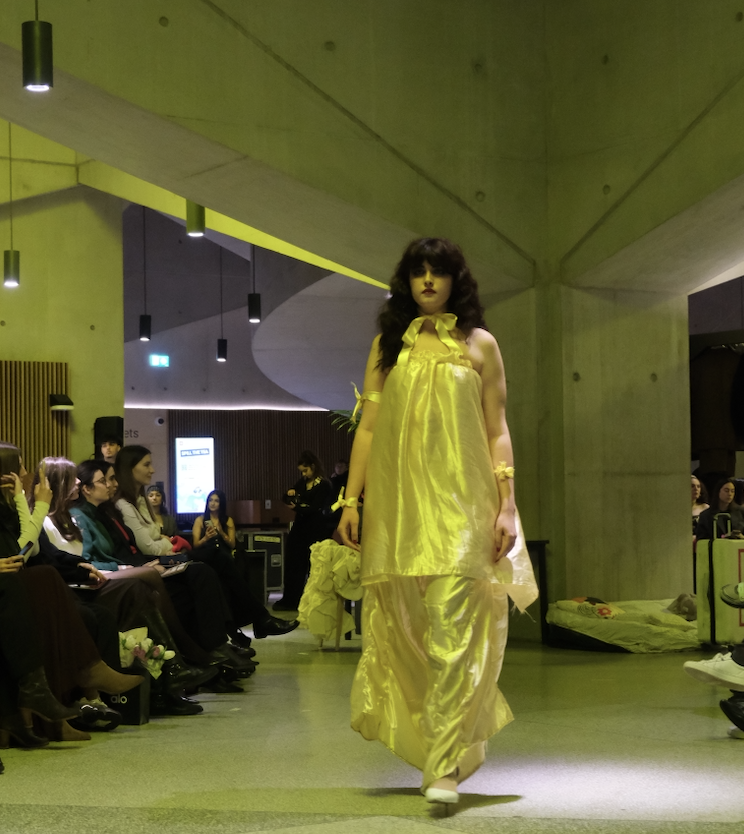
Angelika Santaniello’s look, designed by Guilia, stood out in particular. A flowing yellow top and matching trousers in a satin-like fabric were described as “transcending archaic traditionalist confines of a cultural uniform”. The silhouette felt freeing, challenging the suffocating atmosphere of corporate London. Chiaki Ishiwata’s piece, modelled by Tamara Postlethwaite, pushed this idea further. A clear blazer paired with heels offered a literal transparency—a “deconstruction of the suit” that exposed rather than concealed. Inspired by the idea of being naked and fully authentic, the look stripped the corporate uniform back to its outline.
This act reclaimed the theme. No longer absorbed in the suits of London’s corporate sphere, cultural capital was reshaped into something less uniform.
Act 5: Choose Yourself
The final act asked the question at the heart of the show: Can freedom coexist with the corporate dress code? Here, elements of the suit returned. Grey, black, and white fabrics reappeared but reshaped, with asymmetry and softer tailoring. The corporate material remained, but its authority had shifted. One outfit from this act featured puffed sleeves with pointed shoulders, hip cutouts, and pinafore material tailored to the model’s body.
The line from the soundtrack, “the world is your oyster”, described this shift. The student was no longer rejecting the corporate dress code but redefining its boundaries.
The final walk brought every model back to the runway. When seen together, the transformation was undeniable: the suit had moved from rigid uniform to something more flexible, defined by self-expression. What began in Act 1 as a reproduction of corporate conformity, by Act 5 had moved to a personal interpretation.
Once again, the RAG Fashion Show proved that creativity has not been lost at LSE. Bryon’s interpretation of ‘Culture Capital’ felt strikingly relevant to a university obsessed with a single trajectory. By reworking the traditional suit and the common aspiration behind it, the show highlighted the intersection of creativity and career, serving as a reminder that we still get to choose who we are inside the uniform.