
Written by Angelika Santaniello
Photography by Tom Scott
For the football fans among Beaver readers, I’m sure we’ve all heard at least a handful of supporters have something to say about the action on the pitch. For the most part, it’s usually about the referee’s decision. Sometimes, you even get supporters wishing they could take the manager’s role, shouting ‘cross!’ or co-ordinating a specific pass. At least, in my experience, these types of technical comments end up diffuse, lost in the game’s commotion.
But what happens when fans actually have a say in how the club is run? We may be familiar with the 50 + 1 rule in the German Bundesliga, where club members are to hold the majority of voting rights, to protect the club from an excessive exertion of influence by outside investors.
While this isn’t something we tend to see in other football leagues, it’s clear that fans don’t enjoy when business executives are the ones making decisions on running the team, whether it be cutting spending budget for the year or not firing controversial managers.
For North-London-based National League South team, Enfield Town FC (ETFC), fans have a direct say on the Club’s running. Formed in 2001, the Club is the first wholly fan-owned club in the UK.
Being from Enfield and having gone to a few games myself, I wondered what this meant for the day-to-day running of the club, especially in a time when a club’s status and players’ popularity are heavily driven by their club’s income.
Hearing from the Board:
I first spoke to Vice Chairman Paul Millington about how the club’s ethos links to his vision of success. According to him, it is about “having a football club that will be here for future generations […] I like to think we prove something [on and] off the field.”
How can the ‘off the pitch’ element be taken further? This points to questions as to whether this model can be the new norm for football teams. Millington admitted the model exists within a UK structure “very much based on the historical system”, explaining “it is a struggle […] we do need [to] consider whether we’ve hit a ceiling”. He seemed more hesitant to be entirely optimistic – the club “can’t compete with those [professional] teams financially”.
That’s not to say being fully fan-owned creates an ‘unworkable team’ – supporters want to see their club grow. On this, Millington commented on ETFC’s ‘Doing it Together’ crowdfunding campaign in 2024 to improve the home grounds, which raised over the target of £35,000.
“We have been very lucky that our support base has been very generous to us over the years.” But, the club is “aware that [they] need to move out of that area, because [they] can’t keep going back to the same people for money all the time”.
For a club centred on avoiding “going back to the same people […] all the time” – it’s important to reflect on how all people in the local community can get involved with the club’s project. Our minds may first go to thinking about those left out in the international dominance of men’s football.
John Carrigy (Vice Chair of the Enfield Town Ladies FC) commented on the team’s use of their platform to increase the participation of women and girls in football, as one of the largest and longest established girls and women’s football clubs in South East England. He observed, “We currently use our platform really well.” “We want to promote it even further; we want to grow and keep growing to encourage more girls to play football.”
Speaking on behalf of Lisa, the Chair, he emphasised that “Lisa is really passionate about the growth of girls’ football in the area. Both our daughters have played for the club.”
Millington also spoke about the club’s accessibility arrangements, explaining that “we generate our own funds to [fund all parts of] these […] activities.” “To continue, we need to […] [have] an infrastructure to have the people with specialist people to deliver that type of course,” he concluded.
How does the club’s ethos extend to social media?
We must admit that the large majority of football fans do not, and most certainly cannot, attend all matches – the ‘match of the day’ more-often-than-not happens online. While football’s fate is not left to social media, we can’t deny that fans engage with online polls, match updates, and interviews posted online perhaps more than the live content.
So, where can the ‘raw’ enjoyment of online football content come from? This may need an entire article in itself, but, at least for ETFC, this comes from the grassroots efforts of fans and volunteers.
To gain an insight on this, I spoke to Gabriel, ETFC fan and volunteer for the club’s social media team, about what it means to be an ETFC fan.
He believes, “as members we have a genuine stake in the club […] It brings you closer as a supporter […] It does offer a […] different nature of supporting and football, especially at our level.”
Extending to the use of social media to shape the team’s image, Gabriel neatly summarised his approach: “It’s not just a [Unique Selling Point], it’s something we do really have to abide by.” Clearly, content becomes more personalised, encouraging more direct involvement from fans in what is portrayed as a wider community project.
The Beaver Goes to Enfield:
To get a glimpse of the supporter-owned club spirit, I went to their men’s first team home game against Maidstone United – who were placed 11th at the time of the match compared to ETFC’s standing in the relegation zone at 21st – on Tuesday 25 November.
For the 612 fans in attendance on Tuesday, there was perhaps a wave of worry as to whether ETFC could keep their winning streak after beating Farnborough FC 5 – 1 the previous Saturday.
I had the opportunity to talk to captain Mickey Parcell (who was unable to play) ahead of the game about what fan support means for him as captain and as a player on the pitch. He emphasised that “you feel [fan] interaction more whether you feel that on the pitch from people watching”.
“You see this club means a lot to people,” he summarised.
Indeed, this couldn’t be clearer than what I saw at the home stand, around the pitch, and at the bar.
The first half of the match saw an oscillation in supporter optimism, seeing Reynolds’ missed opportunity to score, instead hitting the advertising boarders, and Moore’s finish at the 41st Minute, giving Maidstone a 1 – 0 lead.
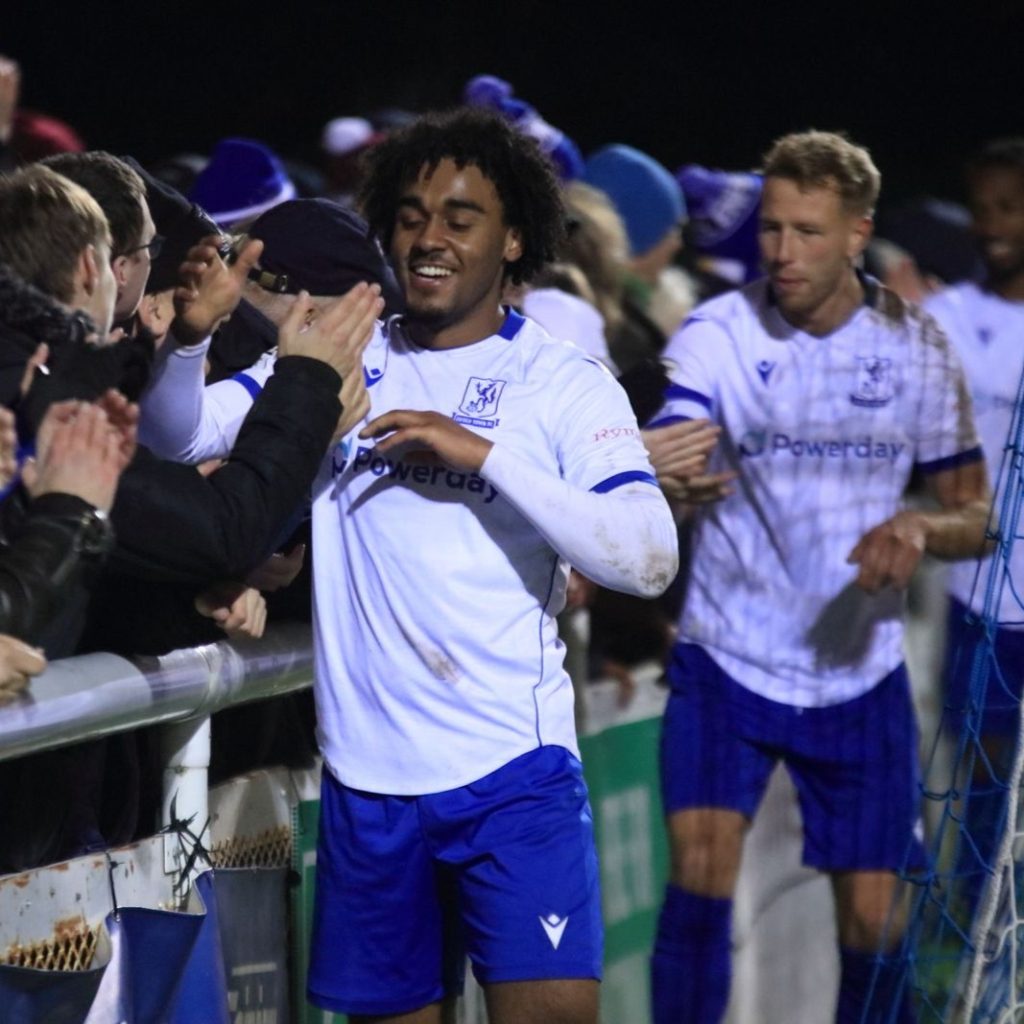
The fans’ perseverance pulled through in the second half. Youngs scored the equaliser, chipping the ball in at the 63rdminute after a cross in to the 6-yard box. Reynolds secured ETFC’s victory at the 69th minute. For the fans watching from the stalls and at the bar attached to the stands, the enthusiasm was clear, with everyone celebrating loudly and clinking their beer glasses together.
Fans were in for a tough match on a cold Tuesday evening – players were in for an even harder battle it seems, as ETFC players pushed to get their second win after a loss spell across previous matches.
Reynolds captured this sentiment when I spoke to him after the game. Before joining his teammates to celebrate their performance at the stadium’s bar, he took the opportunity to dedicate a core part of his success to fans: “They’re like our second win, they give us a little bit more of a boost, that little bit more of a fight. They’re loud every game, they travel with us.”
As we can see, there is a certain vibrancy to a fan-owned football club model. It adds to the inherent dynamism of the sport and builds the community atmosphere integral to smaller local teams. I think the Club’s approach is best summarised by the engravings on one of their scarves at the merch stand – ETFC focuses on ‘making friends not millionaires’. What we are yet to see is whether or not this will extend to bigger teams.
