
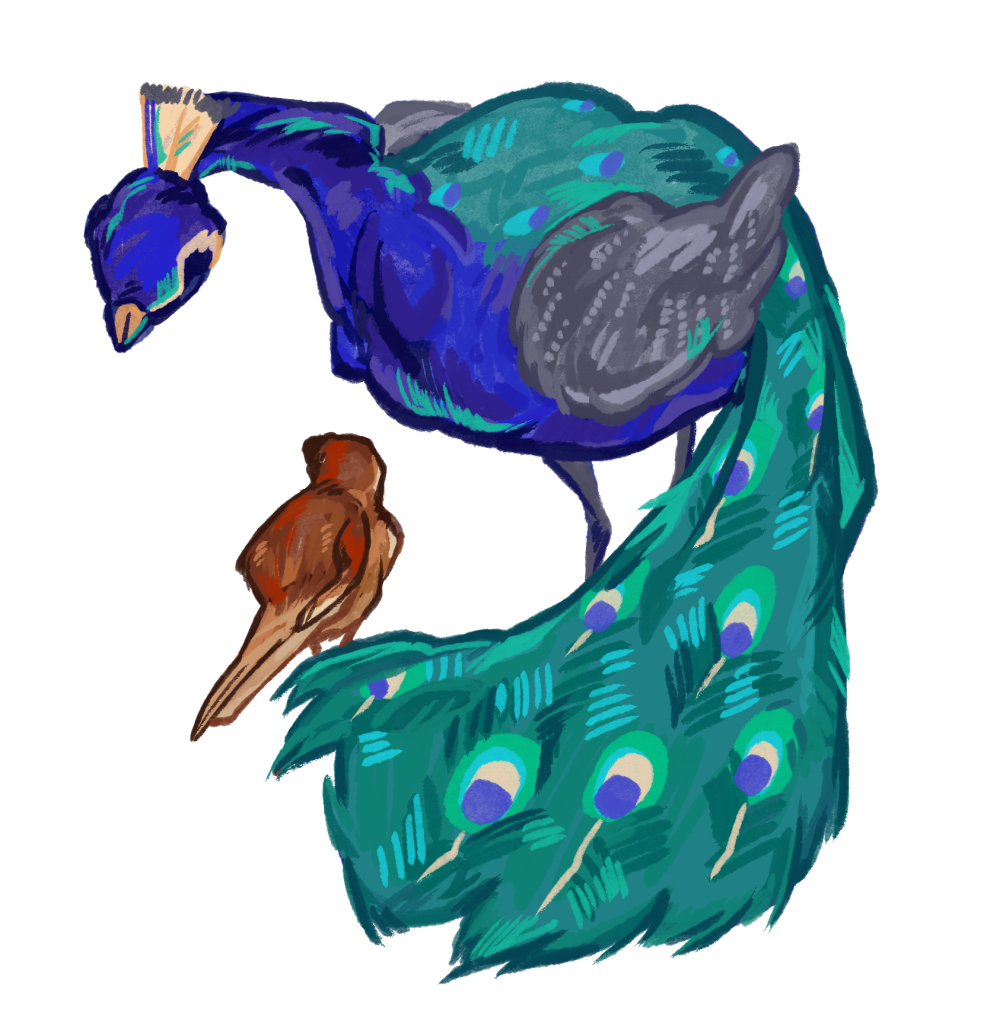
Written by Zara Noor
Illustrated by Sylvain Chan
“Right and wrong existed on paper, but in reality, all that existed were the amorphous masses of in between”.
These are the words of Shane Collins, jaded and ethically ambiguous, serving as a CIA operative in Bahrain. They are one of the many lines that lingered from LSE alumna I.S. Berry’s outstanding debut novel The Peacock and the Sparrow, long after I finished reading. Recently, I had the wonderful opportunity to hear more about her journey into writing, from her time at LSE to her personal experience as a spy in the Middle East.
Despite her numerous accolades as an author, neither writing nor intelligence work was the original plan for Berry. Law school seemed the clearest path until study abroad prompted a change in direction, so to any law students reading this, just know it’s never too late to escape the training contract ordeal. As a general course alumna, she looks back to say: “LSE, quite literally, changed my life. I loved living in London, which inspired my lifelong passion for foreign affairs, global cultures, and travel, all of which underpin my writing. Living abroad, you’re exposed to different viewpoints and perspectives, and I think this, too, has strongly influenced my work.”
LSE taught her to think in “a uniquely rigorous, methodical and critical way”, naming Professor Dougherty in particular as a transformative influence. In her novel, this analytical and diverse worldview stands out on every page — Berry doesn’t let anyone off easily. All are subject to her unflinching scrutiny, the material outcomes of unthinkable choices illuminated under her magnifying glass.
After her time in London on exchange from America, Berry worked as a newspaper editor in Prague, before applying for a career in the CIA. Her goal, she attests, was always to “write something meaningful”, but she hadn’t yet found the right story. Working as a spy gave her the perfect inspiration — a job filled with deceit, manipulation, and traumatic decisions.
Far from the glitz and glamour of Hollywood films, the reality of spy craft she portrays is much more complex. She tells me: “It’s a job where you manipulate people and they manipulate you. You’re preying on vulnerabilities. You’re typically breaking the law in another country. Everything is a calculation and a compromise, and you learn to view the world as transactional. It’s a job that makes you cynical.”
It is, therefore, no surprise that cynical and calculated are apt characterisations of her novel’s protagonist, Shane Collins. He is an aging, unscrupulous, alcoholic, divorcé in the twilight of his career, navigating extremely difficult personal quandaries and political instability. He’s complicated. Thinking of him brings me back to his musings, that ‘right’ and ‘wrong’ are not straightforward to define. Berry shows us that people situated in international conflicts make decisions for multi-faceted reasons, from radicalisation to trauma, corruption to lust. No character is merely a victim, villain or hero- all grapple with the impossibility of belonging to a single ‘side’. American operatives are far from being presented as saviours.
The trauma present in the pages is palpable, and Berry describes it as her own “ghosts” haunting the fictional narrative. She shared with me one of the most affecting operations of her CIA career — “helping to apprehend an alleged high-value terrorist target in Baghdad — only to learn years later that we might have arrested the wrong person”. She describes it as a “moment of reckoning”, asking the question: “Had I saved or ruined a life?”.
Her account reminds me of another memorable line from the novel: “You were just doing your job.”Collins hears this from his valued informant, reassuring him after an allegedly self-defensive act of violence. Berry admits that although she didn’t realise it at the time, the parallels between her and her main character are “as plain as day”. Both are caught up in a fast moving, dangerous world of duplicity and must reckon with the consequences of actions committed in the name of their profession. It makes me consider how many more ‘Shane Collins’ will be produced by American intervention in the Middle East, and how many will come to regret their choices.
As The Peacock and the Sparrowis grounded in real conflicts that had devastating human costs, I wondered how Berry approached the responsibility of drawing on these events. Berry replied: “Such a great question. The Arab Spring was a legitimate, noble, democratic movement, and I never wanted readers to lose sight of that. My book depicts hardline elements hijacking the movement to some degree, which reflects reality, but I was careful to distinguish between these elements and the vast majority of genuine reformers and activists. I tried to portray the costs, heartbreak, and disappointment of the Arab Spring with sensitivity, sympathy and accuracy.
One of my characters, Junaid, is based on the real-life Bahraini dissident Abdulhadi al-Khawaja (currently imprisoned in Bahrain on a life sentence), and I wanted to pay homage to him as a kind of figurehead for the movement.”
Taking inspiration from real-life operations comes with even more challenges than I anticipated. Berry, as an ex-CIA agent, was forbidden from showing her work to anyone, even her husband, while she was writing. For five years, she lamented being “holed up in a coffee shop”, unable to get feedback from anyone — “it felt like a huge leap of faith”. In my opinion, it’s safe to say her leap paid off. I found myself entirely engrossed in the evocative descriptions of Bahrain, the clandestine arrangements, and the rising action culminating in tragedy. The green apple cigarettes shared in beaten-up cars, the fisherman’s shack looking out at the sea. It left me with a deeper appreciation of human fallibility, and a simultaneous frustration with the mindset at the heart of the conflict- ‘us versus them’.
The climax of the novel particularly cemented this for me, without wanting to give too many spoilers for anyone wanting to read her remarkable work. Characters we root for, cry for, are angry for, can always surprise us in the end. Berry may have left the CIA, but her talent for manipulation is alive and well — she’s simply shifted targets from informants to her readers.
From lawyer to agent to author, what is next for I.S. Berry? I was thrilled to hear that she is not moving on from writing any time soon. In fact, she has a second spycraft novel in the works, a prequel to The Peacock and the Sparrowtelling the unsung backstory of the leading female character. Berry gives me the synopsis: “A half-British, half-Iraqi woman volunteers to work for Belgian intelligence, penetrating an Al Qaeda cell in Europe during the Global War on Terror. It’s a story of radicalisation and redemption, the conflict between East and West, being an outsider, and the paths we take. As in my first book, much is inspired by actual events.”
As our conversation came to a close, I was left with one more burning question. What advice would she give to aspiring authors, looking to write their own debut? “Find your voice. Find what makes your writing distinctive. Don’t be discouraged or surprised if inspiration doesn’t strike until you’ve racked up years of living”, was her answer.
I wonder in the years of living yet to come, what stories I will come away with at the end of it all. If there is anything I learned from Berry, it’s that seemingly small choices can change everything. For her, studying abroad at LSE sparked a career in the CIA. For Shane Collins, simply buying a mosaic led to bloodshed and betrayal.
I can’t help but ask myself which of my own small choices will be ones I can’t turn back from.

