
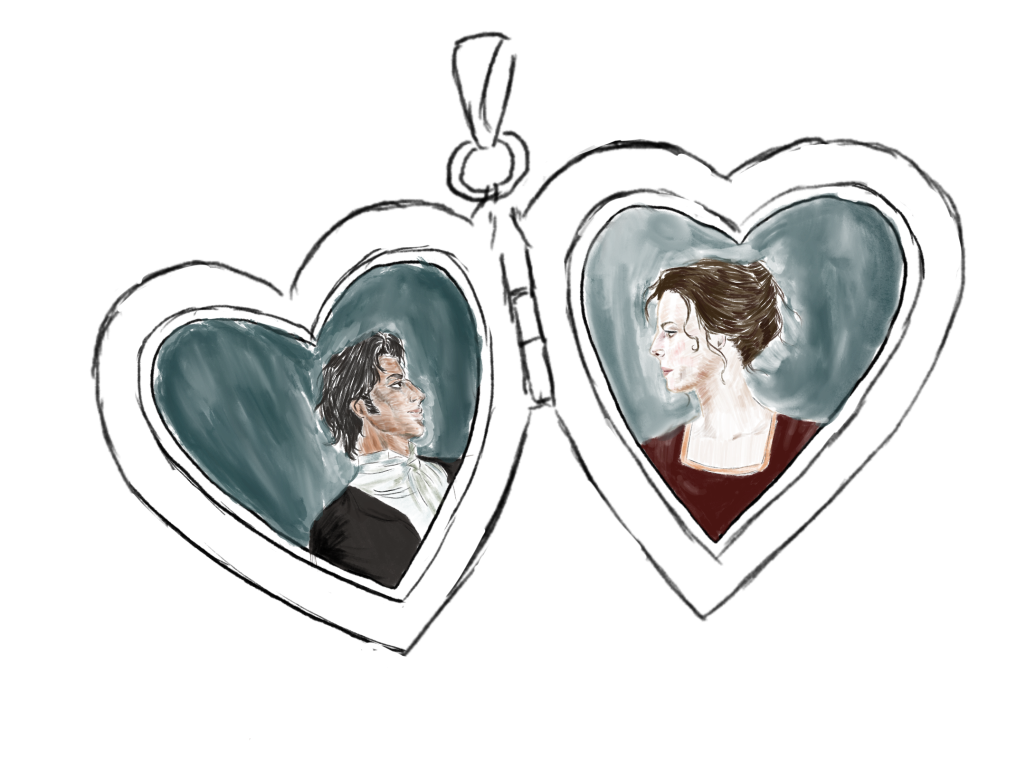
Written by Chloé Cerisier
Illustrated by April Yang
Emerald Fennell’s new movie adaptation of the gothic romantic novel Wuthering Heights by Emily Brontë seems almost deliberately designed to stir controversy. Re-styled as “Wuthering Heights” to distance itself from the original material, the film aims to depict the film Fennell imagined at 14, when she first read the book. Even before the cameras started rolling, the internet went wild over the casting of white Jacob Elordi as the ethnically ambiguous Heathcliff, but that is far from the only major change Fennell made.
Before diving into the (many) criticisms of this movie, it is worth noting some positive aspects. First of all, it looks great. The costumes are spectacular, thanks to Oscar-winning costume designer Jacqueline Durran, with every single one of Catherine’s (Margot Robbie) outfits drawing attention each time she stepped on screen. The sets are also very impressive, notably the wild Moors, rendered almost mystic with the thick smoke and use of shadows, mirroring the characters’ inner turmoil. The contrast between Wuthering Heights and the Grange, the two main homes of the novel, was equally striking, packed with imagery representative of class and wealth disparities. The Charli XCX pop/electronic soundtrack works surprisingly well with the movie. Much like the costumes, which are not period-accurate, it modernises the story and offers another perspective on the 1847 novel.
But here comes my issue with this film: it is marketed as an adaptation, not a modernisation or an interpretation of Brontë’s novel, but a book-to-film adaptation. And this feels nothing like an adaptation.
Heathcliff (Jacob Elordi) falls short of his book characterisation. Wuthering Heights, the novel, relies heavily on Cathy’s brother Hindley. When their father, Mr. Earnshaw, brought home a young orphan from his trip to Liverpool and named him Heathcliff after his second son, who died during childhood, both Cathy and Hindley grew deeply jealous. This sparked the first main conflict of the story. Hindley resents Heathcliff for being raised in status despite being an orphan with dark skin, resorting to abuse that made Heathcliff’s life a living hell after the passing of Mr. Earnshaw. This is what fuelled Heathcliff’s rage and lifelong aspiration for vengeance against Hindley and, later, his children. Fennell completely erases Hindley from existence in her film, and with him, the very reason why Heathcliff turned out to be such a violent character. She gave Mr. Earnshaw many of Hindley’s traits, but the father comes nowhere near as vile and cruel as Hindley was. And one of the reasons for that is that “Wuthering Heights” does not address race the way Brontë’s novel did.
Heathcliff is not a white character. It is unclear whether he is supposed to be Black or Brown, but he’s described as a “dark-skinned gypsy in aspect” and “as dark almost as if it came from the devil”.
And this has major implications for the treatment of his character. It is integral to the story, as racism was one of the motives behind Hindley’s abuse of Heathcliff. It is also one of the main reasons why he and Cathy could not marry. No matter how rich and successful he may grow up to be, his dark skin will forever single him out in society. To date him would be to degrade herself, like she says in the film. But by making them both white, Emerald Fennell erases this. When asked about her choice to cast white Australian Jacob Elordi for the role, the director said, “You can only make the movie that you sort of imagined yourself when you read it.” The fact that at 14 she could not imagine a dark-skinned actor, even though he is described as a “gypsy” and a “lascar” in the book, is very telling.
More broadly, the two main characters were miscast. Catherine is brown-haired and dies at age 19. While Margot Robbie is a great actress, one might question whether she can pass for 19, which makes Cathy less a wild child with arrogance and defiance, and more a whiny rich girl. The same goes for Jacob Elordi, as Heathcliff is supposed to be 19 or 20 by the end of the movie’s timeline.
Other characters like Nelly (Hong Chau), Joseph (Ewan Mitchell), and Isabella Linton (Alison Oliver) are also unrecognisable. Nelly’s moral ambiguity is replaced by a one-dimensional character seemingly driven by deep hatred for Cathy. Joseph is no longer a religiously violent man but becomes a servant who is into BDSM with three lines of dialogue. Worst of all, Isabella turns from a naive, innocent girl who is tortured by Heathcliff after their marriage into a kinky, obsessive, and mean person. In the novel, she escapes Heathcliff’s abuse while pregnant, throwing her wedding ring in the fire. This was groundbreaking at the time of Brontë’s novel, when women were the legal property of their husbands. In the movie, Fennell reduces her to a willing BDSM participant, chained and treated like a dog, but seeming to enjoy it. Rather than turning the story towards a different message, Fennell’s choice removes any depth whatsoever from the characters.
“Wuthering Heights” is sold as ‘the greatest love story of all time’ at the expense of almost all of the novel’s other themes. Brontë’s work was about revenge, class struggle, power, whiteness, and generational trauma. Rather than incorporating these tensions into the relationship between Cathy and Heathcliff, the film instantly pairs them together as soulmates, star-crossed lovers separated by circumstance. This is not the toxic love portrayed in the book. Everything unspoken and rich with ‘maybes’ was simply resolved, explicitly having them talk about their feelings to each other and repeatedly showing them having sex throughout the movie. Fennell’s Heathcliff is not brutal or terrifying like the characters tell us over and over. He never behaves abominably and even asks for consent to use Isabella to avenge himself against Catherine, which she turns out to enjoy. The taboo of Cathy’s desire for him is thus completely void of meaning in the film. Heathcliff is not a man who abuses the innocent Isabella, having murdered her dog on their wedding day; he is nothing more than a horny and moody newly rich man. Catherine is not a torn girl corrupted by the workings of the world; she appears innately mean and stupid, obsessed with Heathcliff, who comes nowhere near the monster he is supposed to be.
Such narrative streamlining is nothing new for book-to-screen adaptations.
Of course, this isn’t always a bad thing. Take Stanley Kubrick’s interpretation of The Shining, for example. He considered Stephen King’s book as a jumping-off point rather than a full guide for his movie. But it didn’t matter because Kubrick’s The Shining stood on its own as a masterpiece. “Wuthering Heights” is not a new interpretation of Brontë’s novel. Fennell doesn’t add new dimensions, reframe storylines, or reinterpret the material to make it her own; she simply strips the original story of all its intricacies. Emily Brontë’s book is about characters who are hateful but still full of enough complexity that we are desperate to learn their messy tale. Emerald Fennell’s film is merely about two people overcoming obstacles to fall in love. There are plenty of movies loosely inspired by classic literature (Clueless, 10 Things I Hate About You, Anyone but You, for example) that acknowledge their influences but do not claim to be adaptations of the original, as Fennell did with Wuthering Heights.
And this matters. At a time when we rely increasingly on AI for everyday tasks, when we do not read as much, and when polarisation has replaced nuanced debate, promoting a film that dumbs down one of the greatest novels of the 19th century as a ‘love story’ is dangerous. I have seen many people say that this movie is very enjoyable without an “annoying English lit major in your ear”. And that scares me. Literature is by nature political, and Wuthering Heights is no exception. This is not just a ‘fun time.’ It feeds into our current literacy crisis. It is whitewashing. It is an erasure of the original material. I would have no problem if this film had been billed as an original. But if you have seen the movie and think you are now familiar with the story of Wuthering Heights, please go read the novel and realise how far you were from the truth.
