Written by Kiara Tay
Illustrated by Sylvain Chan
‘LSE Drops Every Department That Isn’t Finance or Management’, ‘Hare Krishna Man Accepts Goldman Sachs Internship’, and ‘LSE Economics Lectures See Record Attendance on Valentine’s Day’. These snappy headlines, while gloriously untrue, are the unmistakable signature of The Raccoon (@raccoononline), the LSESU’s premier satire publication.
Rooted in its irreverent Instagram beginnings and now a full-fledged society, The Raccoon has long occupied an ambiguous position in the LSE media ecosystem, being frequently mistaken for an extension of or direct rival to The Beaver.
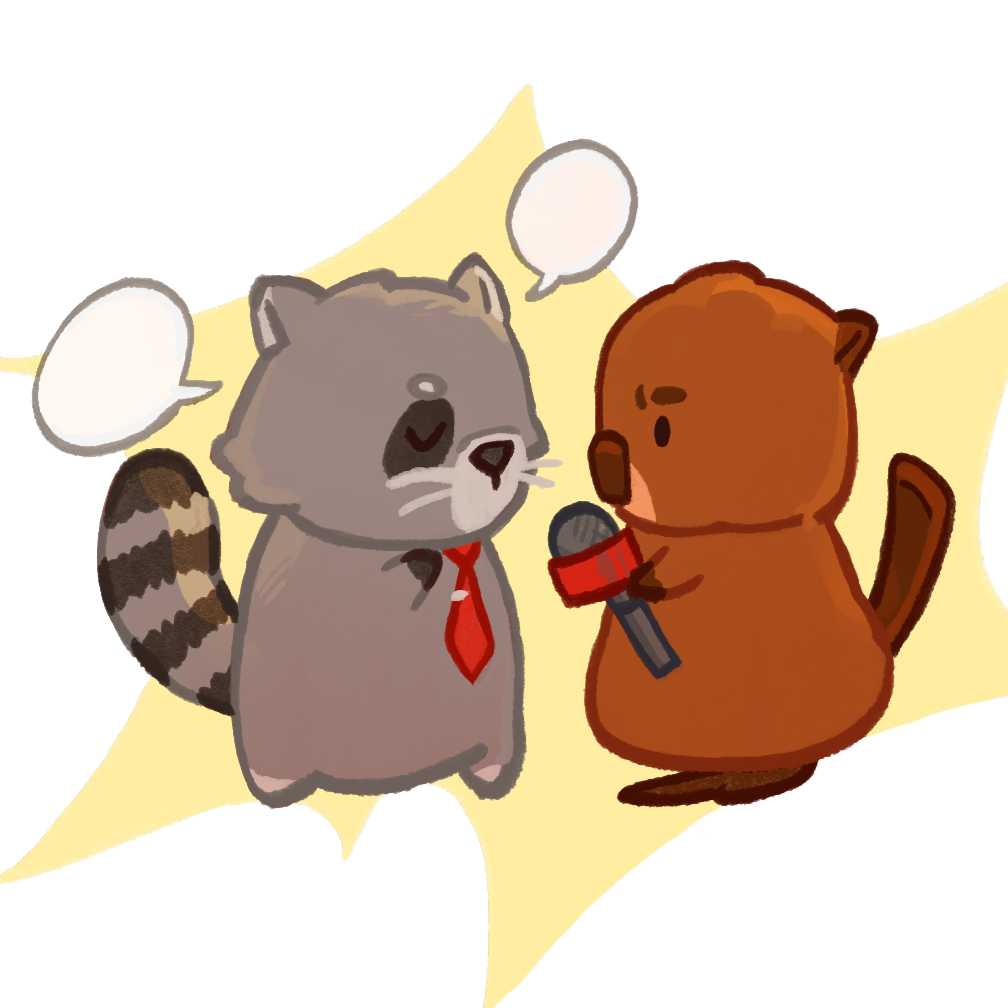
I sat down with Felicia the Raccoon™ to see what lies behind the society’s mascot, spirit animal, and inspiration (The Editor-in-Chief was unavailable for comment).
The day of our interview, Felicia the Raccoon™ arrives at our CBG meeting spot five minutes late. She is dressed sharply in a suit, topped with a bright red coat that perfectly treads the line between professional and audacious — a fitting metaphor for the publication it represents. After some hissing (raccoons take a while to adjust to human language, we are told), she proceeds to kindly tell me that its lateness was a calculated power play to assert dominance. Having been rendered momentarily speechless, I have no choice but to quickly start the interview.
Let’s begin with a simple question: what does satire mean to you?
Felicia thinks for a while before answering: “That one monkey scratching chin reaction image.”
“You know the one,” she continues. “It’s the perfect representation. People assume The Thinker is a universal symbol of intellectual and creative struggle… but I say it’s that monkey. Satire should make you do exactly that: to think more deeply about something and chuckle about it. That mix of whimsy and thought is exactly what we’re going for at the Raccoon.”
Considering LSE’s seemingly more academic focus, Felicia reveals a crucial point of contention: How would this extend to creating a legitimate space for satire?
“In a more conventional university,” Felicia explains, “satire would take small nuggets of ridiculousness and exaggerate them to the point of hilarity.”
“At LSE, however, we can simply write what’s happening. This is a surreal institution at times: the overwork, the never-ending job hunt, the glitchy course selection system. Satire offers a more digestible way to call out these things, in a more accessible and humorous form.”
It is especially in LSE, where students are often too focused on their academics and work, “where they need a way to engage with what’s going on around them”.
Moreover, a key feature of The Raccoon is its staunch commitment to anonymity.
Unlike The Beaver, no articles carry bylines. Is this a strategic decision?
“Oh, it’s absolutely intentional,” Felicia the Raccoon™ confirms, waving a paw dismissively. “We don’t want that pressure on our creative minds, and it helps having some plausible deniability when we are talking about certain issues.”
She adds that “more importantly, by having no names, the reader is invited to become the author. They are The Raccoon. We are all raccoons gathering trash together in the sewers. There is a kind of solidarity in that.”
Moving on, could you clarify the relationship between The Beaver and The Raccoon?
“We’re completely separate organisations that occupy different areas of the media space. We don’t clash often, but when we do, I think it’s kind of like a fiery sort of opposition. Like a …” She pauses. “Like a Heated Rivalry.”
“Honestly, this dynamic would make excellent television,” she jokes.
Let me ask you the million-dollar question: Do you think The Raccoon is better than The Beaver?
“Easy. Consider the animals we are. What is a raccoon? We’re scrappy, we’re always fighting and fending for ourselves on the streets. […] There’s no way I wouldn’t beat him in a fist fight. This reflects in our stories. We cover the important issues that actually affect the masses.”
I begin to counter her argument —”But The Beaver also reports on pressing issues!”— when her beady black eyes narrow. She leans in closer and whispers accusatorily, “I heard Felix the Beaver was the one who implemented Meatless Mondays in LSE Halls. Are you sure you don’t want to switch sides?”
And with that, before I could ask another question, she whipped her tail theatrically and left in a flourish, its bright coat casting a red shadow in her wake.
While the Raccoon may have some one-sided animosity against the Beaver, I would like to offer a truce: The Raccoon provides readers with unique angles and much-needed chuckles, while The Beaver provides a steady stream of relevant fact-checked news stories. Their whimsy complements our groundedness, and we both have important parts to play in the LSE media ecosystem.
Unfortunately, Felicia’s suave exit was short-lived. From across the foyer, I watch as she struggles to time her entrance into the CBG revolving door, her oversized coat catching on the frame twice before she finally slips through and disappears into the Holborn night.
As the door spun lazily behind her, I was left alone, notebook in hand, with the unmistakable feeling that no profile — no matter how carefully constructed — could ever truly pin down the true essence of Felicia the Raccoon™, nor the publication she represents.
Though I suspect that’s exactly how she wants it.