
Written by Andrei Salimi
Illustrated by Anonymous
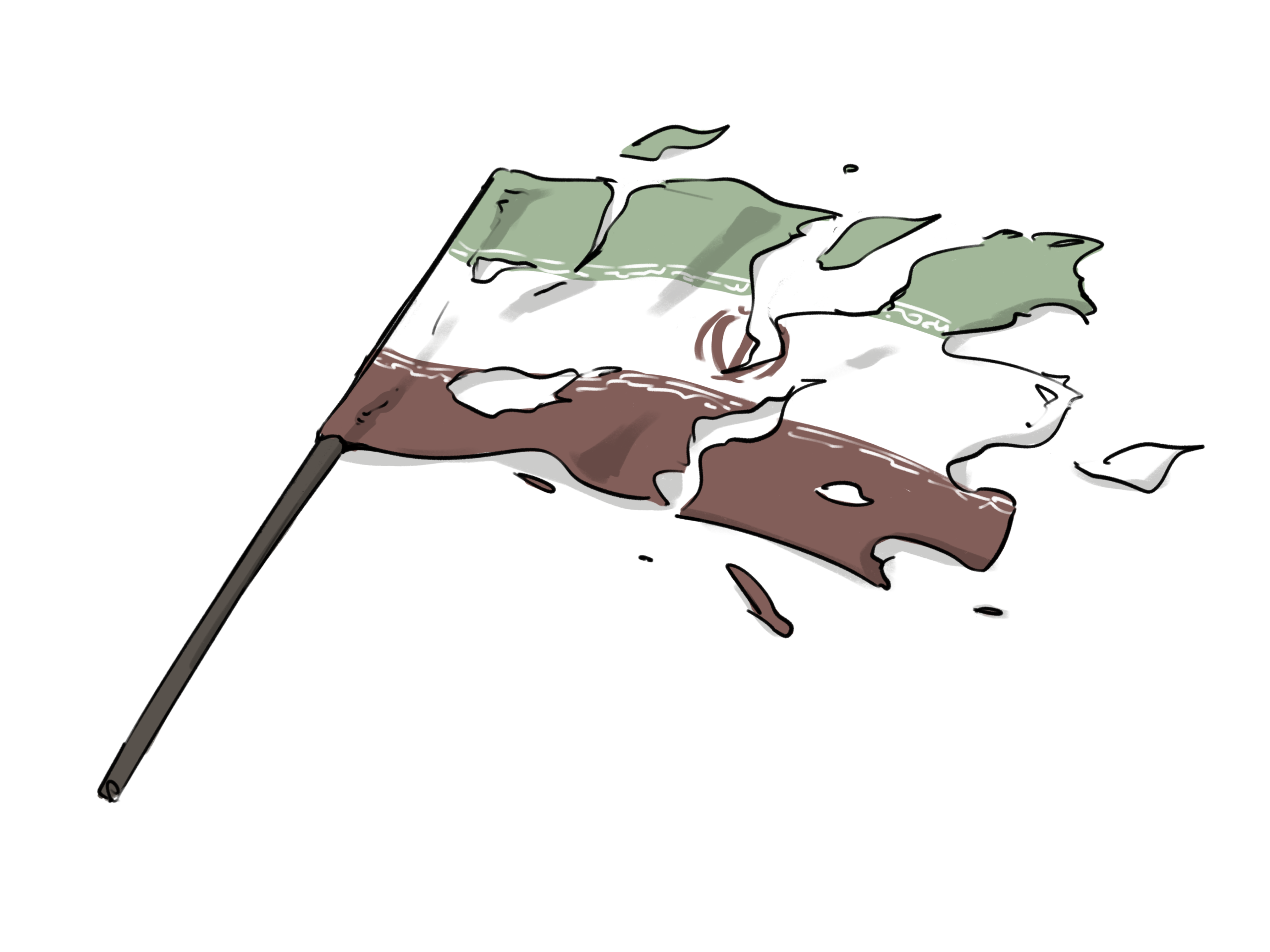
For more than three weeks, Trump’s war on Iran has been marked by seemingly endless contradictions. First, Secretary of State Marco Rubio implied that Israel dragged the U.S. into war. Using circular reasoning to justify attacking first, he explained that the U.S. was aware of an Israeli offensive plan which would “precipitate an attack against American forces”, thereby requiring preemptive action. The next day, Trump refuted Rubio’s statement, claiming to have possibly “forced Israel’s hand” in bombing Iran first.
Trump’s overarching justification for bombing Iran has been just as confusing. It floats between regime change, ending the nuclear programme, and balkanisation, to name a few, yet none are logical arguments. To enact regime change, Trump indirectly installed a religious hardliner whose father, mother, wife, and children were killed by American strikes. Now, in place of Ayatollah Khameinei’s willingness to negotiate on nuclear enrichment, we will likely see an Iranian government composed of bitter ideologues all too eager to produce a nuclear deterrent.
To add insult to injury, the question of reining in Iran’s nuclear programme was categorically solved under the Obama administration with the 2015 Iran nuclear deal (JCPOA). Trump unilaterally broke the terms of the agreement in 2018, thereby singlehandedly renewing Iran’s nuclear programme, not ending it. Most strange of all, though, are Trump’s musings on using the Kurds to balkanise Iran — an absurd proposition for anyone who has even an inkling of Iran’s multi-ethnic nature, or international law for that matter.
The lack of serious justification for Trump’s war in Iran is unprecedented in practically all modern American military operations. Even Bush claimed Iraq had weapons of mass destruction, giving a clear, albeit false, reason for invasion in 2003. Regrettably, Trump’s feeble explanations for this war are most reminiscent of Putin’s similarly bizarre justification for invading Ukraine: that the Ukrainian government is run by Nazis and needs to be denazified. Both arguments are stunningly simple in their usage of Hitler’s ‘big lie’ maxim: “The broad masses… more readily fall victim to the big lie than the small lie.”
Even members of the Iranian diaspora who are well-versed in politics, some of the Islamic Republic’s most perceptive critics, are unsure of how to interpret Trump’s war. Ryan Modarres, an LSE PPE student and head of public policy at Rosefield Strategic Advisory, explains that, “The official justification presented for the war has shifted in ways that make it hard to pin down, and only time will reveal whether history will judge the war as the correct course of action.” Outright support for the war is dwindling, leaving in its place confusion, if not dismay.
Increasingly, it feels like only Netanyahu and his coalition government have clear objectives in bombing Iran. Netanyahu, a conservative populist, openly boasts of having wanted to fight a war with Iran for 40 years. Now, he has the most right-wing government in Israeli history, a compliant ally, and multiple corruption trials to reckon with, from which military conflict is a welcome distraction. Additionally, he has to handle the backlash from his massive security breach scandal surrounding the October 7th attack as well as near constant democratic backsliding, both issues for which attacking Iran provides ample distraction for.
Interestingly, Jewish Israeli support of attacks on Iran is near universal, despite widespread loathing of Netanyahu among more liberal elements of society, which the Israeli Prime Minister is surely hoping will translate to popular support in the upcoming elections. Indeed, he has been following a well-known playbook. To keep the conflict going, Netanyahu has extended Israel’s ‘mowing the grass’ approach previously only used with immediate neighbours to Iran, essentially bombing the country haphazardly to destabilise and weaken it.
Trump, in contrast, doesn’t seem like he knows his own objective in bombing Iran. In spite of his copious usage of “big lies”, his constant waffling begs the question of whether he has a definite reason for the attack, however unscrupulous, of his own. The political fallout related to Israel’s recent bombing of the South Pars gas field paints a damning picture of who controls the operation. After the attack, Trump claimed he wasn’t informed it would take place and forbade the Israelis from striking the field again, doubtlessly due to domestic energy cost concerns. Pitifully, Netanyahu had to reassure him, saying, “He’s the leader. I am the ally. America is the leader.”
Now, Trump claims to be “winding down” the war, while simultaneously deploying more troops. There is no end in sight to the bombing campaign, nor chance of a dignified retreat for the Americans. It is practically impossible to understand why Trump’s War on Iran is taking place, except from a far-right Israeli perspective, which Joe Kent, Trump’s former top counterterrorism official, corroborates. In wanting to stabilise spiralling energy prices, Trump is now caught between a rock and a hard place, and he is making increasingly paradoxical decisions. Most strangely, while actively bombing Iran, he has lifted sanctions on some Iranian oil, as he did for Russian oil in prior weeks. It is becoming increasingly clear that not even Trump knows what his goals in Iran are, let alone anyone else.