

Written by Emerson Lam
Photography by Jasmine Wong
Home to the eighth largest international student population at this school, Hong Kong has a unique dynamic with the UK. This dynamic is informed by its status as a former colony that had strong historical links with London, amplified by political tensions and reinforced by a settlement scheme restarted in 2020 which allows for many to take permanent residence.
LSESU Hong Kong Public Affairs and Social Service Society (HKPASS) is the main society catering to everything relating to Hong Kong. Their flagship event, LSE Forum, can be a platform for both impactful political discussion and retention of Cantonese representation at a time where many argue the identity of Hong Kong is under threat.
Having attended the Forum for the past two years, this event has stood out to me as highlighting a different side of LSE: one that sees both the honing of debating skills and the showcasing of language.
Political debate and discussion at a school of Political Science
This event places participating teams from other universities into a bracket, with those placing first within the bracket advancing into the semi-finals. The debate topics covered Hong Kong policy, such as the pros and cons of promoting a tobacco-free society, and philosophical questions including whether one should measure their personal progress against their peers. Watching the back-and forth arguments of each team was extremely entertaining, as everyone went all out, showcasing their debating skills.
As a school with a heavy focus on contemporary issues and the study of subjects such as political science, regular discussions already take place about similar topics, allowing for the society and hosts to have experience guiding the direction and narratives of the debate.
I spoke to Gordon, a former co-convenor of the LSE Forum and HKPASS’ current Public Affairs Officer, who believes that local policy changes often get lost in the grand study of comparative policy and international relations.
“For Hong Kongers living abroad, many often lose touch with local news topics in favour of governmental policy in England, mainly due to how immigration policy and local UK news apply more towards us,” he told The Beaver.
At the same time, people who have moved to the UK continue to care about what happens back home: “We should still regularly follow news about life and society and how different changes in policy impact the people we know.”
So, for Gordon, the event is an opportunity for people “to learn more about what exactly is happening back home and to train our debating skills in the meantime”.
On the other hand, the format’s incorporation of more philosophical questions provided a different, more exciting experience for debaters and spectators alike. This is because “telling the debaters to discuss policy-related questions is not as challenging as having them speak about philosophy.”
“The nuances of philosophical questions help train up critical thinking and are useful for crowd engagement. Arguing philosophical positions in an abstract manner often cannot directly appeal to the judges, so the debaters usually end up using direct personal references to support their point. In both years of the finals, the points that debaters raised have given the crowd a good laugh, giving the mostly serious event a happier tone to finish.”
LSE Forum as a Means for Cantonese Representation
At the same time, unlike most other debating competitions, LSE Forum is strictly in Cantonese. As one of the highlighting policies of the debating format, this rule has been strictly enforced throughout the years, going as far as to penalize anyone who uses English during the debate.
However, this unique format has been well received by both debating amateurs and seasoned veterans alike.
Kyle, a Forum participant from Oxford who had previously qualified for the World Debating University Championships, offered his perspective on this:
“I think a unique thing about the LSE Forum format is that it offers quite a lot of focus on direct engagement since you have 4 minutes of free debate for each side and the 1v1 format, in comparison to other English debating formats.”
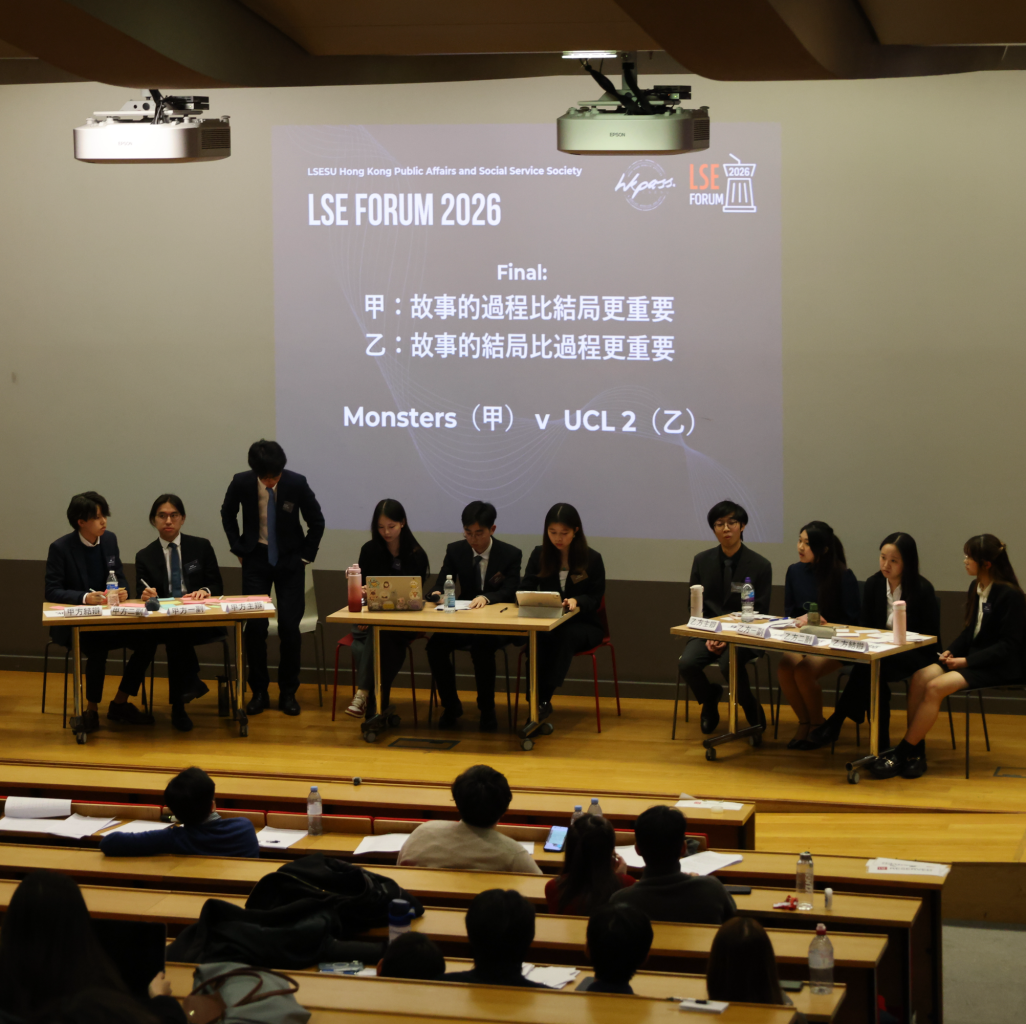
Regarding the role of “strategy” in the process, Kyle notes this adds a “dynamic” quality to the debating experience. “I quite enjoy the challenge of being forced to be quick on your feet when responding to counterarguments,” he summarises.
Beyond that, Cantonese is a diasporic language, spoken by many immigrants who have moved abroad to other countries. Many often talk about Cantonese as a ‘dying language’, whether in its usurpation by Mandarin in China or the natural decay of second-generation immigrants. This makes the language’s representation in media, such as the newest season of Bridgerton, all the more important.
Having a platform such as the LSE Forum reinforces one’s ability to speak the language, allowing for people to stay in touch with their cultural identity.
Hong Kong, Politics, and University Life
Finally, Hong Kong itself has become a contested talking point over the past decade. Following the 2019-2020 Hong Kong Protests and implementation of the National Security Law, many from Hong Kong have come to the UK for a new life under the British National (Overseas) Visa, which includes many current university students both at LSE and in the UK.
Their status requires political navigation from both Hong Kong, which has seen human rights watchdogs attack the government’s gradual limitations of the free press, and the UK, which has been embroiled in discussions over immigration.
In this environment, where it becomes easy for many to feel lost about their identity, it arguably becomes all the more important to host an event that allows for discussions to take place. Kyle puts it best:
“I really enjoy debating Hong Kong issues because I find it important not to lose touch with recent developments and current affairs in [Hong Kong] even when I’m in the UK.”
“I still consider Hong Kong my home,” he explains.
“[A]ny changes there still impact me, and, given that systematic and in-depth debates that focus on Hong Kong are hard to come by in the UK, the LSE Forum is a crucial platform for maintaining this discourse and bringing together bright minds from Hong Kong.”
Conclusion
If you’re not Cantonese, having an event hosted in a language different from your own may seem alienating, perhaps not worth reporting on as part of campus life. However, in a globalised world, diasporas are highly prevalent. For many people from Hong Kong, the UK is still a different country, a 13-hour flight away from their home, so it’s great to have the LSE Forum as a community that celebrates part of what makes us unique!