Written by Aaina Saini
Illustrated by Jessica Chan
I would call this book simply devastating if it didn’t also feel so quietly merciful. With every struggle and battle that our down-to-earth, matter-of-fact and downright hilarious protagonist —Luke— undergoes, the book flattens strife without any apology, and presses on tender bruises, and yet, almost perversely, leaves the reader feeling more steadied than shattered.
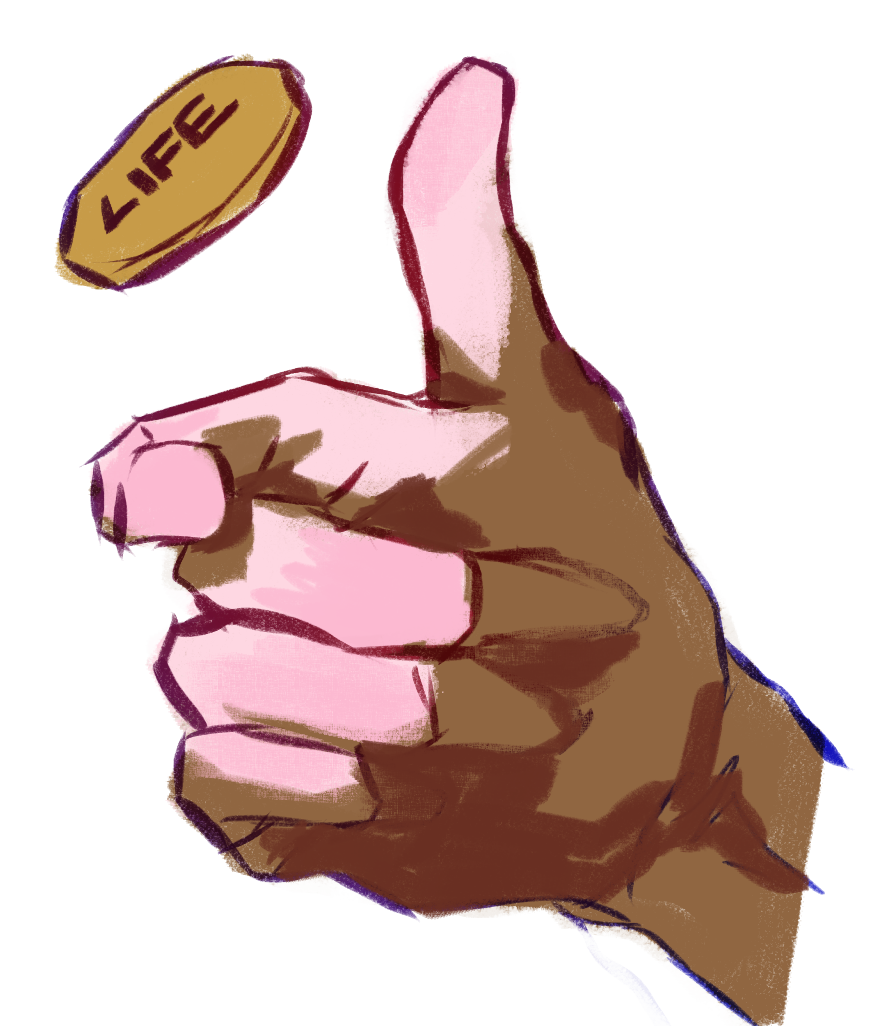
Even in its bleakest passages, —Luke’s daughter refusing contact with him, or the news of Julie’s death— the book finds the strength to keep humming with stubborn optimism. It does not deny suffering, but instead folds it into a larger rhythm of life. The book is titled correctly in saying “‘Life —- A Fifty Fifty Path?”’ because I closed it not naive to pain but resigned to life’s ups and downs, accepting that the rise and fall are not interruptions of the journey but the journey itself.
The simple beauty of the book is highlighted by its writing style, where the prose is quite understated and barely changes tone for the big moments. It simply lets the facts carry the weight of the matter— making this an easy read. However, Kirkaldy subtly weaves in period detail through cultural markers with simple mentions of college scarves, Oxford ties, the Beatles, ‘The Ye Old Horse’ being just outside the LSE campus (strange, right?). These establish the era and help jump between the time lags the author moves between without much elucidation and trusts the reader to catch up with the author’s quick pace.
For all my insistence on plumbing its depths, what I perhaps haven’t stressed enough is this: the book is outrageously funny. It is not politely amusing, or mildly clever but truly, disarmingly funny. It wields that dry, slightly crude British wit with impeccable timing, tossing off comments about “‘sagging tits”’ or the absurdity of students once affording housing in Kensington, with such casual precision that you’re caught laughing before you’ve quite recovered. The humor is quite elastic and stretches from the slyly intellectual to the unabashedly crude, generous enough to meet readers wherever they stand, whether young and irreverent like me or older and all too aware of the joke.
The novel also carries the weight of the fact that while life is ever-changing and transient, it insists just as firmly that some things endure. Whether it be Henry and Luke’s heartwarming friendship that seems to be strong no matter what, or the simple act of taking Julie to Brighton (yes, LSE students, I see you), it becomes a marker pressed in time. It really makes you appreciate the passage of time and be grateful for the few things that remain constant.
At moments, the novel looms close to reading like an aging man’s wish fulfillment: the constant memory of a dazzling woman who once went away with him, the revelation of a child he could never have in any of his marriages, and even the intimacy with Julie’s sister. These elements threaten to tip into indulgence, specifically as a female reader. But they are handled with a certain narrative neatness, and, while I find myself wincing at the implications, I am ultimately persuaded to forgive it.
Ultimately, this book makes you want to live. And as a university student who harbours her fair share of anxiety about the future, this book eases a reminder that no matter how much planning and scheduling I may do, life has a way of charting its own course. It lingers on the quiet tyranny of small decisions, such as the train you take, the invitation you accept, the person you dare to call, and how these seemingly trivial moments unfurl into entire futures. It insists that luck plays out for better or worse as no one can control the entirety of their fate. It is a beautiful book for when life seems like a cage and is tender without being sentimental, and with a 100% guarantee is bound to make you laugh out loud!
Key Message: To not read this book: Totally and utterly insane idea.