
Written by Sarah Baban
Illustrated by Michelle Sui
As a society, we search for representation. For someone to fill in the gaps; to provide us certainty during instability. When we don’t feel that being fulfilled, disillusionment follows. In an age of despondency, we turn to anyone but our ‘trusted’ politicians. This surge is understandable – why would one continue participating when they don’t feel their needs are being represented, or even listened to?
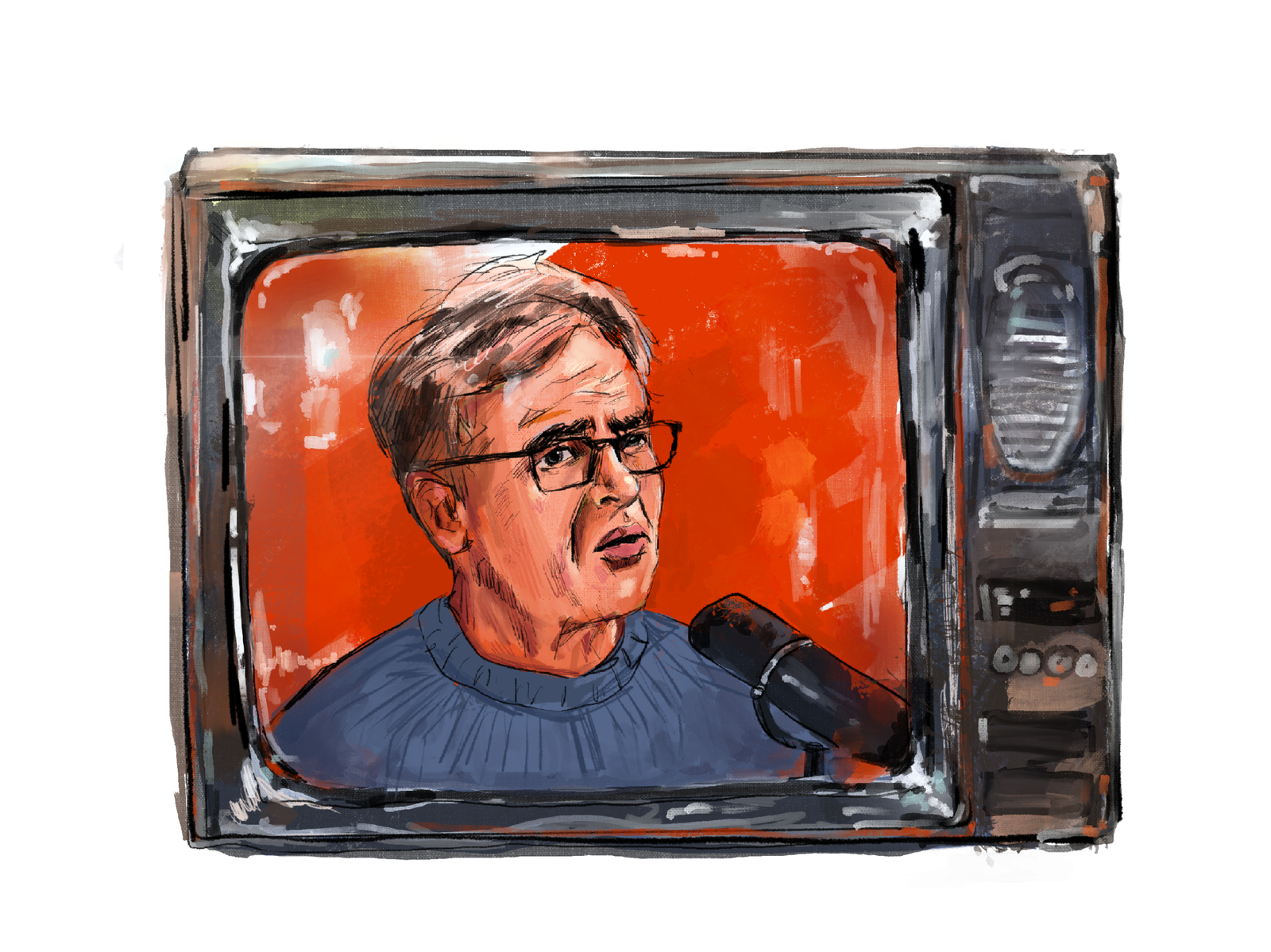
I’m sure you’ve all come across John Kiriakou at least once in your adventures on the internet. He has been plastered next to everyone, from famous political commentators such as Mehdi Hasan or leading podcast heads such as Steven Barlett.
A former CIA-agent-turned-whistleblower, and one of only two that served in jail for breaching the Intelligence Identities Protections Act, he is now a political commentator. And pretty much everywhere…
In today’s disillusioned climate, his story sells. The millions of views and hundreds of thousands of subscribers show a real demand for his stories, experiences and knowledge. His trajectory certainly isn’t like the average man; he has become a bridge between the personal and the political.
Though credible to a certain extent, one has to be wary. We definitely benefit from his insider knowledge, but in the era of populism it has become far too easy for us to rally behind ‘political’ figures. We are fascinated by what he says, sure, but he is not only exposing them – he is exposing himself. In reality, his stories are just flat out confessions, coated in his eloquence.
To briefly explain his complex career, Kiriakou worked in the CIA’s Directorate of Operations to collect foreign intelligence on Iraq, then became a counter-terrorism operations officer in Greece to spy on secular Palestinian revolutionaries, and then later became the Chief of Counterterrorist Operations in Pakistan following the 9/11 attacks.
Though impressive, we must not get stumped by his many accolades. These are not praiseworthy achievements. His various positions expose one thing only: his complicity in a regime that has actively worked to destabilise the Middle East.
The intentions of the modern CIA are not one of peace – they’re one of power-maximising in a world of disordered nation-states. To be a CIA agent is to work for the American government, to serve the interests of the world’s most powerful nation.
Whilst exposing the CIA’s torture programmes for terrorist suspects is admirable to a certain extent, it does not absolve him of his complicity. To assume that Kiriakou was simply ‘doing his job’ and once it compromised his morals, he became a whistleblower, is to unjustly wipe the blood of thousands from his hands. Through his so-called ‘noble’ exposé and fight against the US government, he seemingly presents himself as the good guy among the bad guys. In reality, no such separation exists: he himself is among the bad, just the least bad.
Accusations of him lying have also spread. He has previously claimed that the Indian government was responsible for the 1985 bombing of the Air India Flight 182, when in truth it was Khalistani terrorists of the Babbar Khalsa who were responsible for the atrocities.
On top of this, Kiriakou also worked for Sputnik shortly after leaving prison. Sputnik, a Russian state-funded media agency, is often labelled a propaganda outlet. We all know a miracle would be required for a world where Russia and America will see eye to eye – only recently Senator Mitch McConnell included Russia among the new ‘Axis of Evil’ that included Iran and China.
Transitioning as an agent for arguably the world’s most powerful nation to working for its arch nemesis surely makes one question Kiriakou’s genuinity. Is this not alarming?
Kiriakou serves as a reminder that CIA agents are trained to wear a mask; they are expert liars. We cannot assume that every single story he preaches is one of genuine substance. After all, after losing his CIA money, his newfound fame in the political commentary space has become his new nine-to-five!
The modern age is one characterised by individuals sowing seeds of misinformation and – rather ironically – reaping the fruit of success. To think critically is to break away from a culture that seemingly rallies behind popular figures simply from the skill of their charisma or how funny they are.
Here is the honest truth: these platformed people aren’t like you or me. The decisions of politicians don’t affect them, they affect us.
