A Quick Guide to Sudoku
Written by Ex-Fujo Beaver & the President of SuDLEku Society
When it comes down to notation there are two pathways, either Snyder or full notation. Full notation is simply filling in every possibility into each square and mechanically removing digits until the puzzle is solved. Snyder notation is when you note down a digit in a 3×3 box when it only has two possible positions in that box, and is generally speedier. However, not all puzzles can be solved using only Snyder and thus full notation is much more comprehensive in this aspect. Most of sudoku solving is the process of elimination and spotting patterns.
First, there are hidden and obvious doubles and they work on the same principle; the two digits can only go to two cells in a row/column/box. This eliminates the possibility of one, other digits going to those two cells, and two, the two digits being in the other cells in the respective row/column/box. The only difference between hidden and obvious doubles is that hidden doubles are harder to find because they are in the two cells with other digits, whereas obvious doubles are the only digits in the two cells. Obvious and hidden triples also work the same way, except it is three digits instead of two.
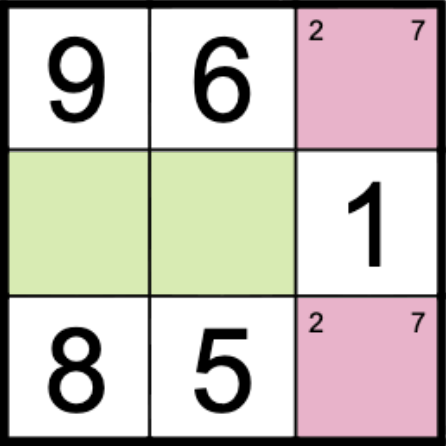
So here, we see that because of the two-seven pair highlighted in pink the three-four pair has to go in the green cells. It cannot go in the pink cells because that would force both two and seven to both be in one of the remaining pink cells. And thus we find another pair! These sorts of pairs are generally much easier to spot with Snyder notation.
Secondly, we have row reduction. This is when a certain digit can only go in that column/row in a box. This eliminates the possibility of the digit going in the other squares in that row/column.
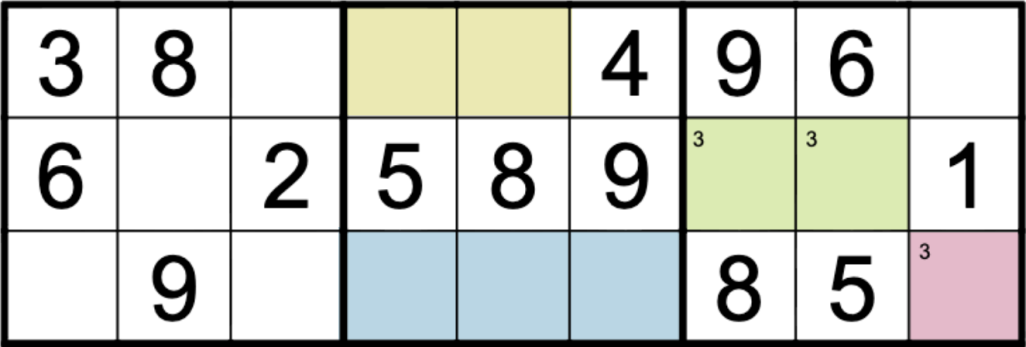
Here, we see that the three in the leftmost box forces the three in the middle box to be in the blue cells as it cannot go in the yellow. As a result, the three in the middle box has to be in the blue cells, eliminating the three from the pink cells and leaving it in the green. Additionally, you could also realise that the three has to go in the green cells by realising that the only place three could go in the second row is in the green!
Aside from this, one way to get faster at sudoku is to change how you scan the grid. When solving, there are a few things you should be looking out for: naked or hidden singles, pointing pairs/triples, and looking at digits that are already plentiful on the grid. Naked singles are cells where only one digit can be placed and hidden singles are cells where it is the only place a digit can be placed. Similar, but slightly different due to nuance. Ignoring its dubious name, naked singles are often the key to solving a puzzle and are easily spotted using full notation, but to save time, you can also check rows/columns/boxes that seem relatively full compared to the rest of the grid.
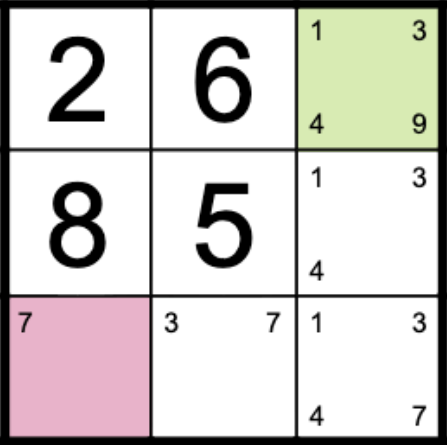
Here, the seven in the pink cell would be considered a naked single as it is the only digit that can go in that cell. In the green cell, the nine would however be a hidden single as it is amongst other digits!
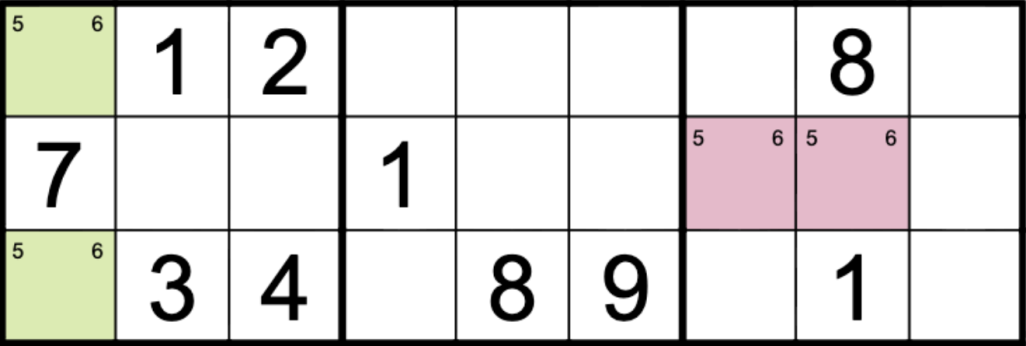
Pointing pairs and triples work in the same way that regular pairs and triples work but across an entire row or column, as we see below with the pink cells forcing the five and six into the green cells in the leftmost box.
That was just a quick guide, but if you’re interested in learning more (and more advanced) sudoku tips, check out SuDLEku society!
A Quick Guide to Cryptics
Written by Joseph O’Keeffe
This is a more daunting one, but with a bit of simple explanation you should be able to get the hang of it. All cryptic crossword clues are built off the same formula – the clues are made up of two separate parts, one straight, and one cryptic. These can come in either order, but always function the same.
The straight element of the clue functions just like a “normal” crossword – the clue gives a straightforward synonym or definition for the answer. For example, cat (6) could be feline. The eponymous cryptic part of the clue, meanwhile, gives a wordplay-based hint for the answer. There are a range of common forms for the type of wordplay used here. Recognising the type of wordplay being used, and getting to grips with solving each type, is essential for getting to grips with cryptic clues.
Below is a list of the most common types of wordplay found in a cryptic crossword, accompanied with my past clues:
1. Anagrams
These clues contain a group of letters that anagram to the answer, placed next to what is known as an anagram indicator. Usually, this is a synonym for a word similar to “rearrangement” (more straightforward), or “confusion” and “untidiness” (more abstract).
Ex → Barber’s so messy, fluid gets back in! (9)
Ans → REABSORBS, an anagram of “barber’s so” with the anagram indicator “messy.” The straight clue is “fluid gets back in”, which means “reabsorbs”.
2. Concealed Answers
This type of clue has a sequence of words, within which the letters making up the answer is physically hiding. Again, these words are put next to an indicator for concealment, often a word synonymous with “containing”. Once more, these indicators can be very straightforward or rather vague.
Ex → Manic unease encapsulates a ward (3)
Ans → ICU, which is hidden in “manIC Unease,” with the container indicator “encapsulates”. The straight clue is “a ward”, which means “ICU”.
3. Homophones
Such clues have a hint for a word that is a homophone (verbally sounds like) the actual answer, put alongside a word indicating the usage of a homophone. This indicator word will be, at ranging levels of directness, a synonym for a word such as “hearing”.
Ex → Singular sound of the heart (4)
Ans → SOLE, which is defined by “singular” in the straight clue. For the wordplay, “sole” sounds like “SOUL”, which “heart” defines. Usage of a homophone is shown by the indicator “sound of.”
4. Charades
These clues are more simple. They just have a definition for two or more words that combine together in their given order to make up the actual answer. No indicator is needed here, but they are sometimes used, here being synonyms for words such as “make” and “create.”
Ex → Snake’s bone floats on water? (4) Ans → BOAT, meaning “floats on water” in the straight clue. This is cryptically clued by “snake”, being “BOA”, followed by “bone”, being “T”, referring to a “T-Bone” steak. There is no indicator present, as is common with charade clues.
5. Removals
These clues have a synonym for a word alongside a word indicating removal. As an indicator word, this is again often synonymous with “removing”. In particular, the indicator itself should make clear what letter needs to be removed – – any synonym of “headless” shows a loss of the first letter, and any synonym of “hollow” demonstrates loss of the letter in the middle. The word created from this removal will then be the clue’s straight answer.
Ex → Success initially absent in round (6)
Ans → INNING. This is “winning”, defined in the clue by success”, without its first letter. The removal here has been indicated by “initially absent”. This creates “inning”, the answer, clued by round.
6. Reversers
In this case, the word that is the answer backwards is clued, next to an indicator for reversing. Once more, this will be loosely synonymous with “reversing.”
Ex → Time one is due to return in date? (3)
Ans → ETA. This is defined by “time one is due”. It is found backwards in “date”, as “ETAd”, a reversal indicated by “return”. The fact this is hidden inside of the word date is indicated by “in”, an indicator for concealed answers.
7. Double Definitions
In this case, the “cryptic” part of the clue is – surprise – just a second definition for the actual answer. As a result, such clues are just made up of two differing synonyms for the true answer.
Ex → Neuter gun (4)
Ans → Nerf. This means both the toy gun, and to neuter.
8. Initial / Final / Alternate Letters
Such clues see a series of words given, with the starting letter of each individual word in the sequence together spelling out the answer in order. Accompanying them is an indicator for such a process, synonymous with “first.” Final or alternate letter wordplay is used in the same way, both with their own indicators, the former’s synonymising “last”, and the latter’s synonymising “every other.”
Ex → The first person involved is irrational (2)
Ans → PI. This is straightly defined by “irrational”. It is formed from the first letters of “Person Involved”, an initial letter process clued by the indicator “first.”
9. Containers
Such clues have two separate definitions for two wholly different words. One of these words is placed around the other to make the solution. They are accompanied by an indicator for this process – here, a synonym for “holding”.
Ex → Green accepted into Russian party initially to earn back losses (6)
Ans → RECOUP, “ECO”, defined by “green”, inside of RUP. This is defined by “Russian”, which is “RU” and “party initially”, which is “P”. The straight clue is to “earn back losses.”
10. Combinations
Such clues are harder – they combine any number of the previously mentioned techniques. Still, the rules I have laid out still apply to every individual aspect of the clue. However, here they are placed together to make up the whole, in a manner similar to the charade style of clue. As such, similar joining indicators, which here would synonymise “with” or “followed by”, are possible but not necessary in these types of clues.
The past container clue for RECOUP is an example of this, as it has both elements of container and initial letter wordplay working in tandem.
This completes the list – if you want to start practicing these newfound skills, try my cryptic crossword for Issue 951! Cryptic crosswords go even deeper than this in types of clue, themes, abbreviations, red herrings, and pseudonyms, but this makes for an ideal crash course. Now for some practice – happy puzzling!
Below are some more great starter cryptics online:
https://www.theguardian.com/crosswords/series/quick-cryptic
https://simplydailypuzzles.com/daily-cryptic
Cryptic Crossword – Unclued Words all have something in common!
A Quick Guide to Connections
You are given a series of words in a 4 by 4 grid. You have to sort these words into 4 groups of 4, all connected by a theme (which can be self-evident, based on wordplay, or pop cultural). Often, there are red herrings or words which can fit into other groups, to stymie the solver, but there is only ever one true solution.
One example would be:
MINUTE CRYPTIC INTER VIEW
REAL CHECK VILLA SUDOKU
AC TICK MOMENT BALL
KNIFE KENKEN SECOND CODEWORD
The four sets of four here would be INTER, REAL, AC, VILLA, all first words of European football teams, BALL, VIEW, CHECK, KNIFE, all words that can be followed by “POINT” to make another word, CRYPTIC, KENKEN, SUDOKU, CODEWORD, all staple newspaper puzzles, and MINUTE, SECOND, TICK, MOMENT, all meaning short periods of time.
A Quick Guide to Word Ladders
You are given a series of clues in a vertical table. Each clue hints a word – for each individual puzzle, all these words will be of the same, stated, length. As you move one rung down (or up) this “ladder”-style table, the answer word will change by just one letter.
For example, SHAMS could go to SHAME or SCAMS, but not to SHINS.
Below is an example of a solved word ladder:
Clue Answer (4)
HELPS AIDS
COVERS LIDS
SUPERMARKET LIDL
Usually, the words at the start and end of the “ladder” (or some highlighted rows) will represent a timely theme, such as freshers, halloween, or graduation.
A Quick Guide to Anagrams
You are given a series of odd phrases, accompanied by a loose theme, often relevant to university life. These are all anagrams of words or phrases that are directly related to this theme – the aim is to untangle them.
One example would be I’D COUNT IN, given as an anagram under the theme FRESHERS’ WEEK. The answer here would be INDUCTION.
A Quick Guide to Strands
Based on the popular NYT puzzle, here you are given a grid of letters. Moving left, right, up, down, and diagonally, you have to find a series of words hidden in the grid as consecutive strings. Together, they constitute all the letters in the grid – each belongs to just *one* word. No letters are repeated.
This series of words consists of a series of theme words and one word denoting the theme. For example, BIOLOGY, PHYSICS, and ENGLISH could be theme words, with the one main strand word being SUBJECTS. The title of the strands puzzle itself will hint to the overarching theme – in that example, the title could be SCHOOL.
A mini example would be:
Animals
P D T
E A O
C T G
Here, the words DOG and CAT are hidden as words, with PET also hidden to show the theme (hinted at by the title of ANIMALS). Together, they fill up the entire grid.