Written by Ruby McKeown
Photos by LSE media relations
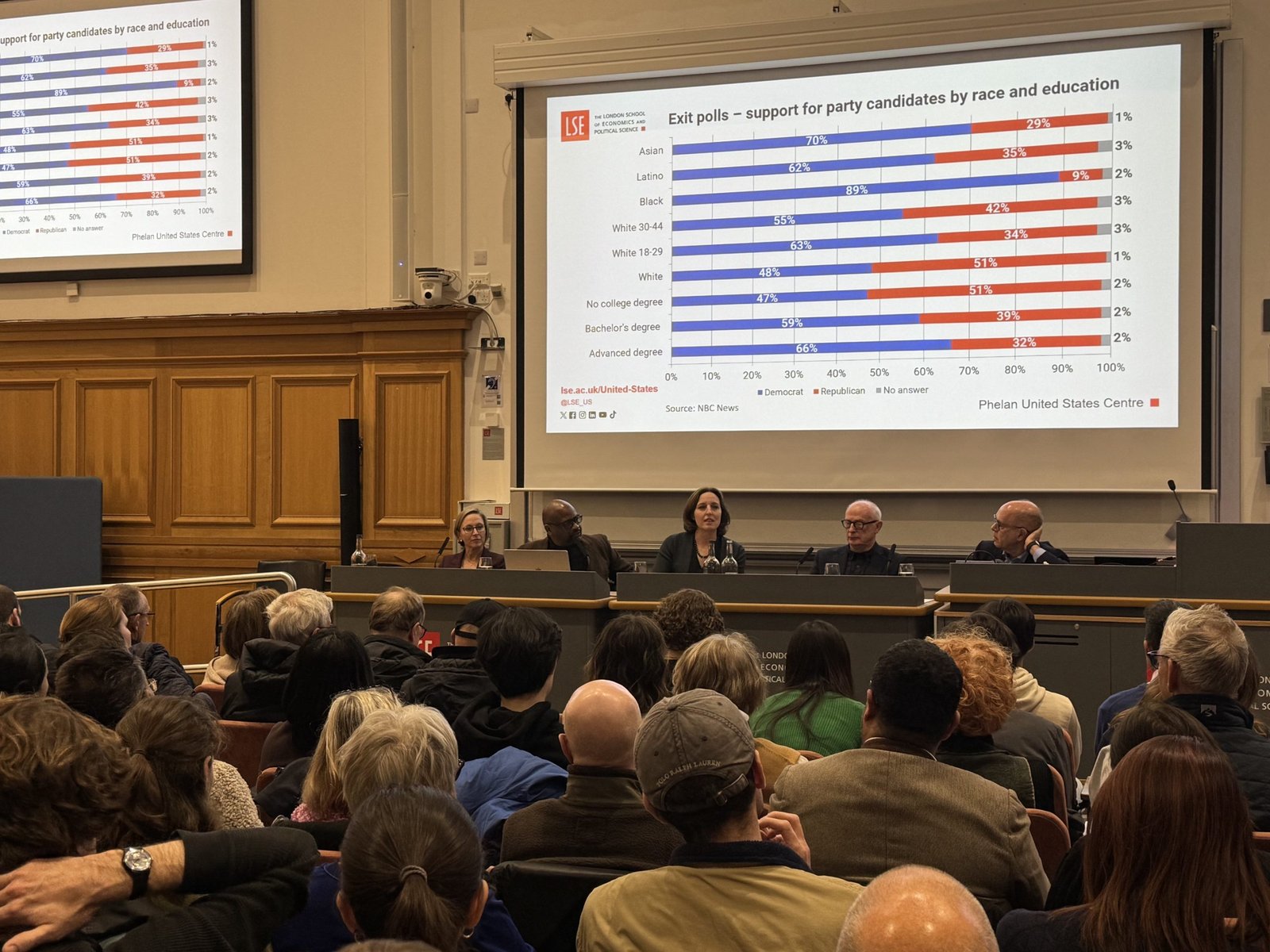
On 4 November 2026, LSE hosted a “Making sense of the US Midterms 2026” panel discussion. The Hong Kong Theatre was filled with attendees ready to hear from Professors Desmond King (University of Oxford), Fredrick C. Harris (Columbia University) and Stephanie Rickard (Department of Government, LSE), alongside Laurel Rapp (Chatham House) and chaired by Professor Peter Trubowitz (LSE Phelan US Centre).
“Trump told Americans to vote as if he was on the ballot, and they did,” Trubowitz declared in his opening statement.
A Historic Election:
“Yesterday was a day of firsts,” Trubowitz said.
One hundred women will take the Oath of Congress on January 3rd. The governorship will see its first Native American woman, Black woman, and Latinx woman in power. Five Black governors were elected. The first Muslim man, Native American woman, and openly gay male won Senate elections. These unexpected results diverge from the Trump administration’s anti-DEI stance.
Harris compared the minority representation in this election with the recent actions of Trump’s government. He cited Louisiana v. Callais, a case in 2026 that overturned racial rights elements of the 1965 Voting Rights Act. Decisions like this mobilized Black voters, 41% of whom view the Supreme Court as the top threat to their community.
Kansas elected a Democrat to the Senate for the first time since 1932, and Texas for the first time since 1988.
“They threw everything, including the kitchen sink at Talerico.” Trubowitz said the Texas Senator-Elect “combined progressivism with bible thumping” to win the historically Republican seat.
Elon Musk reportedly spent between 180 and 224 million dollars on Republican campaigns in Texas alone to prevent Talerico winning office. Texas hosts Musk’s headquarters and main data centers, making this election especially important for him. While Democrats originally brought big tech into politics under Bill Clinton, it moved across the aisle in 2024 when Biden started restricting the industry and AI.
“He [Elon Musk] can’t go back to the Democratic Party. They won’t have him,” Professor King said.
MAGA Becoming a Minority
It appears that the majority of Americans share a negative sentiment with regard to the Republican Party. According to Professor Trubowitz, the 2026 Midterm Elections results have “eviscerated” Trump’s claims that his win in 2024 was ‘a historic realignment’ of the American people.
Professor King noted Trump’s approval ratings sinking to 38%, the lowest of any President in American history aside from Harry Truman. He compared the current era of American politics to the elections that took place after Nixon left office in 1974. Professor Rapp similarly emphasized the magnitude of the results, especially in countering the commonly-held notion that Americans are apathetic about politics.
“Americans are in fact not resigned and are concerned about the direction [of government policies],” she said. “This is the start of the post-Trump era”.
Future for the Divided Government:
All of the panelists appeared to agree that while this election was a big win for Democrats, it still wouldn’t be easy to pass legislation with a Republican in office – particularly one as comfortable using executive powers as Trump. King called his administration a “government by decree.” Many also made mention of Supreme Court rulings that have entrenched Trump’s unitary authority and threatened U.S. democracy.
Right now the Democrats hold the majority in the Senate at 54 seats, but that number could increase to 55 or 56 once the results in Alaska and Mississippi are called. Rapp said the “magic number” of votes in the Senate to break the filibuster and force a vote is 60.
Trump claims he will veto any legislation the Democrat-led Congress tries to pass; gathering enough votes (67) to override a veto will be an important task for Democrats.
Harris predicts the divided government will lead to more shutdowns; “I am not sure, given the temperament of the president, there will be progress on negotiations – particularly the budget”.
Holding Democrats Accountable:
All the speakers agreed that Democrats are going to be held accountable for their actions; therefore, they cannot afford to squander the opportunity this election has given them.
According to Rapp, Democrats face a “defensive imperative” against domestic oversight and an “affirmative agenda” of improving the cost of living. The future holds “a reckoning for both parties, and it’s going to be messy,” she said.
When asked if the Big Beautiful Bill could be rolled back, King suggested that the Democrats can try to restore Medicaid and Medicare; however, it might be difficult given their promise to not raise taxes. King said that the Republicans will blame the Democrats for the nation’s debt in the next presidential election, and they need to start thinking about that now.
“Democrats made this election about affordability,” and “they see that as their agenda for 2028,” King said.
This speaks to the broader trend of the importance of the economy for US citizens that was especially evident in this election. Even Latinx voters, Harris said, were more concerned with “the bread and butter issues” than they were about ICE.
Tariffs:
Trump’s tariffs have had a significant negative impact on the American economy, and the new legislature will need to find a way to address this. Many hope that the Democrats will roll back tariffs and restore some economic order – a hope not shared by Rickard:
“I have bad news Peter…The tariffs are not going anywhere,” she said.
The new Congress cannot revoke the tariffs because the previous government gave Trump the power to pass them through executive order.
Rickard suggested that Democrats could try to make new legislation to reverse tariffs, “but then what?” she said. “It lands on Trump’s desk and he’s going to veto it.” Overturning said vetoes, as mentioned earlier, would take 67 votes, meaning multiple Republicans would have to cross the aisle and vote with the Democrats.
Congress has maintained powers of oversight hearings, and Rickard said she will be watching the House Ways and Means Committee, as well as the Senate Finance Committee closely.
“They have power,” she said, “but they don’t have the power to unwind these tariffs.”
Rickard said there could be a motivation for Trump to cooperate with a Democrat-led Congress and cut tariffs in an attempt to save his legacy. She also suggested Trump could pursue an arrangement like the Biden administration’s bipartisan coalitions for domestic green energy production.
Future of the Republican party:
On the matter of getting Republicans to defect and pass bipartisan legislation, Rapp contended that this might not be so difficult. She spoke to a fissure forming in the Republican party – Trump, on his way to becoming a lame duck, has less power. Party members may begin to distance themselves from him to build a political platform for the 2028 Presidential Election.
Vice President JD Vance is “in a bind,” Rapp said. “A member of the restrainer school of political philosophy,” he internally admitted he did not agree with Trump’s actions in the Iran War. He is now publicly using this to try to separate himself from the administration’s apparent sinking ship.
The Republican party has not seen an election without Trump in a decade, Rapp pointed out. Christian nationalists, evangelicals, and anti-abortion groups found Trump “uniquely inspiring. God likes his appeal,” said King. Moderate Republicans are less enthusiastic about the President, their tolerance perceived to be born out of party loyalty. Now that his power is waning, how current Republican officials operate, including who steps forward to be the party’s next leader, will be very telling for the future of the party.
The Multilateral Community:
Despite the results of the elections, there is still a long road to restore confidence on a global scale. The lack of trust in the international environment cannot be solved in one election. There was a consensus that it would take several elections, midterm and presidential, to undo the damage that has been done.
Rickard stated that the “lack of trust in the multilateral community” is not just because of one person [Trump]. She offered the example of Biden’s continued tariffs on steel and aluminum, which were implemented during Trump’s 2016 administration. Rapp backed the distrust in the international community.
“The post-Cold War era is over. Tariffs are here to stay. We’re not going back to the free trade world,” or, “a pre-Trump world,” she said. Rapp explained that Trump’s second term in office has made allies feel like they were in a dependent, coercive relationship. Europeans have distanced themselves from the US, and there may not be a return to “a pre-Trump” world. Rapp said it “wouldn’t be prudent [for Europe] to reverse.”
This raises further questions about how U.S. Foreign Policy will look moving forward. Rapp predicts that the issue of Gaza will be a “policy reckoning.” She mentioned Trump’s recent remarks outside the White House where he said U.S. military aid to Israel would be cut off by the end of the year – a reversal of his usual rhetoric.
Because the majority of foreign policy falls to the executive, Trump, Rapp predicted that while policy might not change, there could be a more moderate approach to the personnel enacting it. She mentioned that Pete Hegseth, who she went to graduate school with, could face impeachment.
The panel seemed to agree that impeaching Trump is an unlikely move for the Democrats. According to Harris, it would be a waste of time given his lame duck status. To secure their success in the 2028 election they need to produce tangible results that restore the American people’s faith in the party.
This idea of prioritization was a common theme for the panel, and mentioned again when asked what will happen with Venezuela. Rapp said that investigations will be done surrounding strikes, tactics, the unilateral extradition of Maduro, and budget oversight. However, she said that Venezuela has a relative level of security and stability at the moment, and she is not sure if the Democrats have any better solutions right now. Instead, Rapp foresees them letting the current situation continue for the time being while they address more pressing issues.
Future of the Democratic Party:
The ‘Blue Wave’ of Democrats elected into Congress during the 2026 US Midterms is significant for the domestic and international community. The diversity of Democrat candidates will give way to an “open season of idea testing,” Rapp said.
The party’s next leader remains unclear. This election made the Democratic Party even more of a “big tent,” said Rickard. Trubowitz echoed that Southern states are expanding the Democratic Party playing field. The panel discussed the need for the party to find a way to gel mega pastors and democratic socialists into one organization, positing the possibility that the coming era could see a resurgence of native son candidates like Jimmy Carter.
One attendee asked why Trump hasn’t challenged the integrity of the 2026 Midterm results like he did during the 2020 election. On January 6th, 2020, MAGA supporters organized an attack on the US Capital. The panel explained the ‘acceptance’ of this election’s results, quoting an anonymous White House staffer: “It was too big to rig.”
King is not convinced that a crisis like the 2020 insurrection has been averted. He mentioned the recent surge in gun shares and sales leading up to the election: “the threat of a mobilized violent response is very real.”
Even the Experts are Surprised:
Amidst mixed feelings of hope and caution, one thing is certain: the results of this election have taken the world by surprise. Each of the panelists shared what they found most shocking.
King: that the January 6 pardons did not come up, and that eight governors of color were elected.
Rapp: the speed of the election results and the diversity of elected Democrats. She recalled the 2020 election where the Senate did not announce its final candidate until January 6, 2021 – the same day as the Capitol attack.
Harris: the money poured into close races did not pan out as expected. He questions whether the future of the Democratic Party viability will be found in moderate-left “bible thumpers” like Raphael Warnock.
Rickard: the influence of the call to reign in AI and data centers. Typically these centers are built with large government subsidies, which historically, have helped incumbents win, she said.
The new elected officials will begin their terms in January 2027, and the rest of the world will be watching closely to see what this means for American politics.