Written by Casper Fong
Equipment maintenance and repair rarely make headlines, but without them, the quality and consistency top athletes rely on and need to perform at the top level would fall apart.. As someone who came to London from China 3 years ago, I have been able to experience the importance of the sports maintenance industry firsthand, and have even become deeply engaged in the field. While badminton has only been part of my life for a few years, I’ve grown to love it deeply and have even considered a potential career in it, albeit not as an athlete, but as part of the ever-expanding supporting staff that professional badminton requires.
One of the most jarring differences between badminton in the UK and China is the drastic difference in cost. This refers not only to the cost of hiring courts, but also to the fees required to service rackets, mainly in terms of the labour cost for stringing. While a one-time fee of £10 per stringing for labour wasn’t much at a glance, the cost would quickly accumulate considering the frequency with which I needed to restring my racket, along with factoring in the cost of the string itself as a raw material. This inspired me to think about acquiring a stringing machine, not only helping to save money in the long run, but also presenting itself as an excellent business opportunity in a relatively unexplored market.
I began my journey through research into how stringing machines actually work, comparing different manufacturers, and whether over time it would work out financially. While many entry-level stringers seemed to prefer “drop-weight systems”, which used gravity to pull the string to the desired tension, I thought that investing in an electronic system would give me greater accuracy and save me time. To explain the operation of a badminton stringing machine in layman’s terms, the racket is mounted on a six-point racket mount, which gives it stability, and the string gets pulled through the racket horizontally and vertically by either drop-weights, manual cranks, or electronic tension heads before getting knotted off to complete the process. My machine, which is identical to most high-end commercial use machines, is able to do the tensioning process through a panel where the user can set the tension, and the tension head automatically pulls the string to the needed tension.
Since I first started stringing in November of 2024, I’ve worked on roughly 400 rackets, allowing me to break even and make profit. I was able to learn rapidly through various online tutorials from experienced stringers, as well as learning hands-on from the various stringers I’ve known from China. I was able to further increase my experience in this field by working for the stringing team, as a part-time stringer, for Central Sports, one of the largest badminton equipment distributors in the UK. The process of learning this trade has enabled me to engage in a new life skill – acting as a good way to bring in some spare change on the side, meet new people, work at sporting events, and on a side note, is rather therapeutic considering you can be in front of the machine for hours at a time weaving patterns!
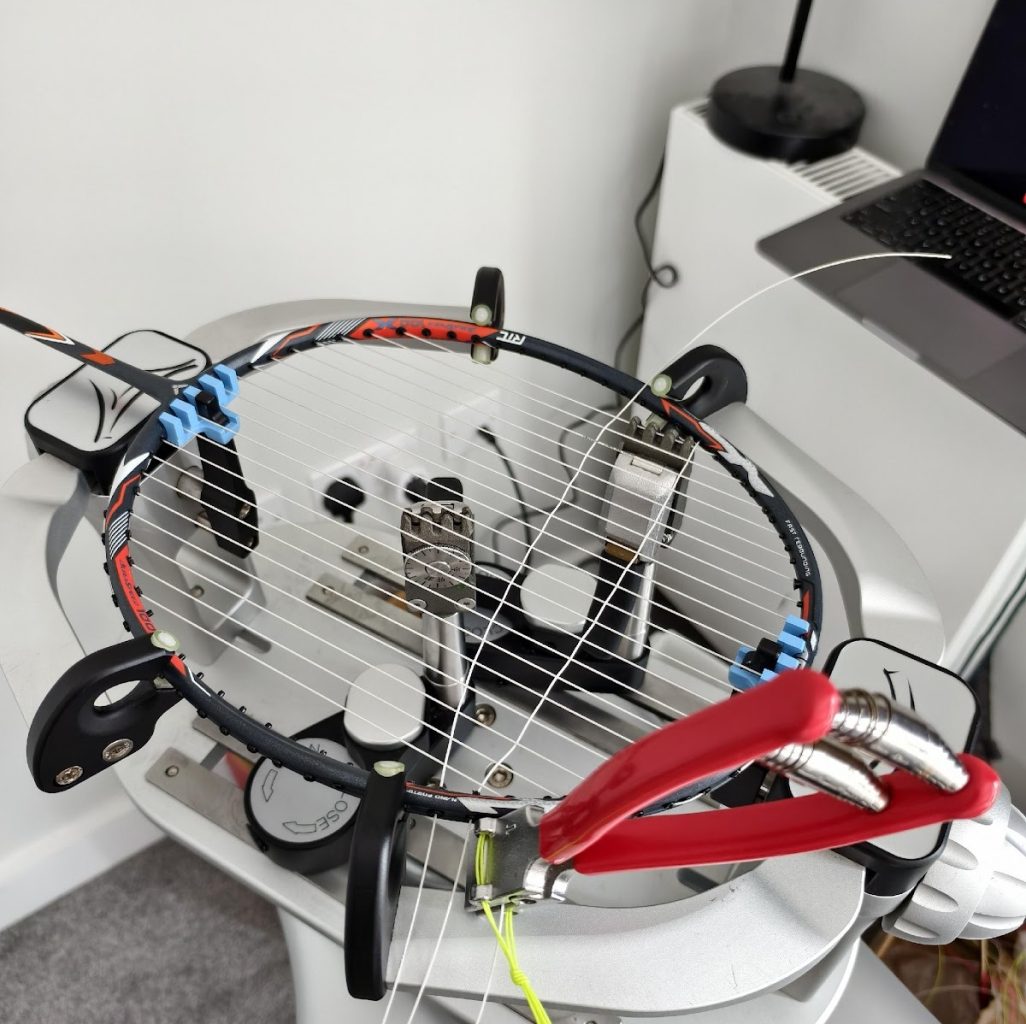
P.S. If anyone wants to know, the stringing method being used is known as “HARIBITO Around The World” by the manufacturer GOSEN.