
Written by Prakriti Maheshwari
Photographed by Joanna Stock
Imagine you’re walking past the Marshall Building to a 9am lecture, coffee in hand – and somewhere inside a former US Secretary of State is on stage talking about climate finance next to the President of Singapore. That’s not a hypothetical, in fact, it happened in June when John Kerry, Tharman Shanmugaratnam, Amina Mohammed, and Teresa Ribera all made appearances at the inaugural Global School of Sustainability (GSoS) Forum. If you were revising for exams in the library that week, you might have missed that LSE briefly hosted one of the most interesting discussions in global climate politics.
That’s the key point about sustainability at LSE: a lot happens slightly out of view, and it’s more notable than you realise.
The celebrity cameo week
The Forum ran alongside London Climate Action Week and the LSE Festival’s strikingly on-the-nose strand, “How to Save the Planet.” Between the panels on green finance and ecological governance, there was even an appearance from Adam Met – yes, the AJR guy, who moonlights as a climate advocate – plus a public art installation called THE HERDS designed to “renew our bond with the natural world.” It’s the kind of programming you’d expect from a Glastonbury side-stage, not a Tuesday at LSE.
The Dean of the GSoS, Jonathan Pershing, framed the week as LSE using its convening power to pull together academics, policymakers, and the wider public to try and move the needle on climate policy, not just talk about it. In his welcome message for the Forum, he described the School’s position as “a platform for global engagement and impact.” Strip away the standard institutional phrasing and the substance is rare: how many universities can get a UN Deputy Secretary-General in the same building as their own undergraduates? The distinction matters because convening power isn’t just symbolic. Putting LSE’s own researchers in the same room as the policymakers who write climate legislation gives academic work a direct route into the policy documents those same officials take back to their governments. This matters because LSE’s case for the GSoS is that the biggest barriers to sustainability sit in the economy, politics and society, so the response has to come from the social sciences. That is what separates this from other universities using similar language: LSE is positioning itself as the place where policy-relevant social science meets the people who write the policy.
Okay, but does any of it actually change anything on campus?
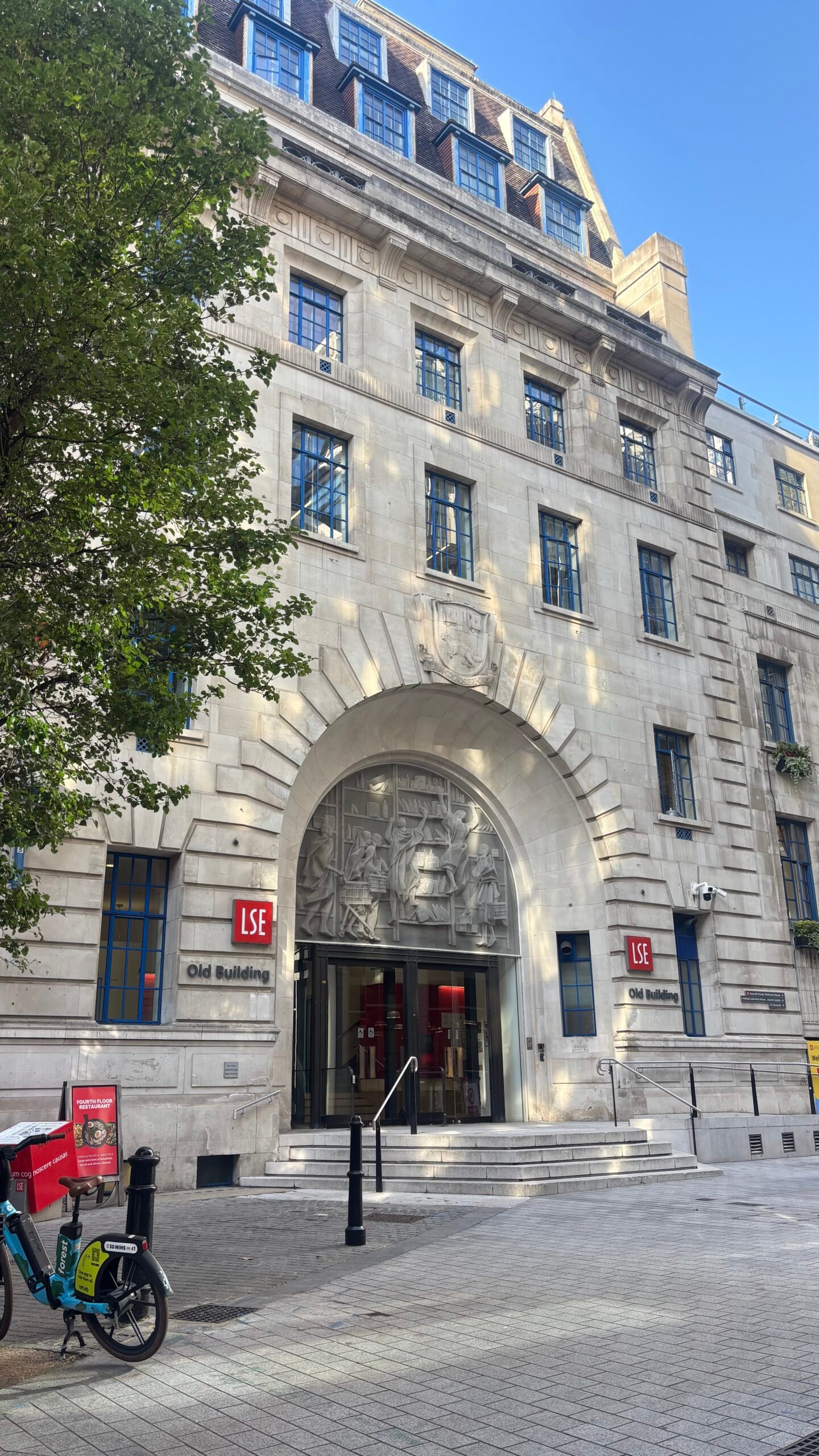
LSE co-founded and now chairs the Global Alliance of Universities on Climate, became the first London University to join the Ellen MacArthur Foundation’s circular economy network in 2022/23, and signed up to the London Higher Sustainability Pledge with twenty other institutions. As a network partner, LSE has committed to embedding the Foundation’s circular economy principles: designing out waste, keeping materials in use for longer, and regenerating natural systems into both its estate and its curriculum, rather than treating the partnership as a one-off announcement. LSE has pointed to the Firoz Lalji Global Hub, a refurbishment that kept around 60% of an existing building’s structure, as an example of that thinking in practice. The school says its direct carbon emissions have dropped substantially since the mid-2000s by as much as 44% since 2005. Buildings like the Old Building have quietly been getting heat pump retrofits that LSE believes will cut emissions by up to 70%. This is the kind of unglamorous infrastructure work that never makes it into a press release but puts into practice what the university has committed itself to
There’s also a target attached to all this: net zero by 2030 for direct energy use on campus, and 2050 for indirect energy use like travel, procurement or supply chains. Twenty years between those two dates sounds like a lot. However, Scope 3 emissions are one of the hardest problems in climate policy for any institution, anywhere, to solve. Having a plan at all puts LSE ahead of many of its peers.
The best bit isn’t even LSE’s doing
If you want the most student-led version of sustainability on this campus, skip the Directorate entirely and go to the LSESU Charity Shop. The shop opened in March 2023 at 31 Portugal Street, in a space that took almost a year to secure, and is run entirely by students. It came out of RAG and the Sustainable Futures Society deciding that fast fashion was a problem worth doing something about, and all its profits go straight to RAG’s charity partners. No press release, no former Secretaries of State, just students who noticed a problem and built the fix themselves. It’s a nice reminder that the flashy GSoS Forum and this scrappy little shop tucked into campus life aren’t rivals for attention. They’re the same instinct, operating at completely different scales.
Where LSE could actually go further
If there’s one place LSE’s sustainability story still has an open chapter, it’s the endowment. Student campaigners have spent years pushing the school to be more transparent about where its investments sit and to move faster on divesting from fossil fuels. A 2024 student referendum on divestment passed with 89% support on record turnout, and LSE’s Council responded by opting to remain invested while launching an ESG policy review: a decision campaigners have criticised as too slow given the scale of holdings identified in LSESU Palestine Society’s 2025 report.
An LSE spokesperson said the school “remains fully committed to strengthening our approach to responsible investment” and will review its investment filters on fossil fuels, tobacco and armaments. The Students’ Union, for its part, says it remains committed to its democratically passed divestment policy, and the Palestine Society report puts at least £131 million of holdings in what it calls “egregious activities.” LSE’s ongoing ESG policy review might be evidence that the institution is listening, but it’s also the most obvious place LSE could turn “How to Save the Planet” from a festival strand into something with more concrete impact. So, is it all just spin?
Universities are very good at making sustainability sound like a marketing copy, and it’s easy to get cynical about any institution that puts on a big glossy event and calls it progress. But LSE’s actual paper trail—the partnerships, the retrofits, the targets, the students quietly building things nobody asked them to—suggests there’s real substance underpinning the Forum’s guest list. For a school with no engineering faculty, “How to Save the Planet” is a strange slogan to commit to unless you’re at least trying to earn it.
Next time you’re cutting through the Marshall Building, and there’s an unfamiliar name on the events board, it might be worth popping your head in. You never know who’s talking, or what LSE’s quietly built since the last time you checked.